UbiA prenyltransferase domain-containing protein 1 (UBIAD1) also known as transitional epithelial response protein 1 (TERE1) is a protein that in humans is encoded by the UBIAD1 gene.[5][6][7]
| UBIAD1 |
|---|
|
| Identifiers |
|---|
| Aliases | UBIAD1, SCCD, TERE1, UbiA prenyltransferase domain containing 1 |
|---|
| External IDs | OMIM: 611632 MGI: 1918957 HomoloGene: 8336 GeneCards: UBIAD1 |
|---|
| Gene location (Human) |
|---|
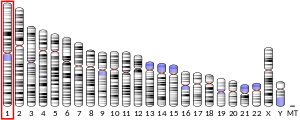 | | Chr. | Chromosome 1 (human)[1] |
|---|
| | Band | 1p36.22 | Start | 11,273,206 bp[1] |
|---|
| End | 11,296,049 bp[1] |
|---|
|
| Gene location (Mouse) |
|---|
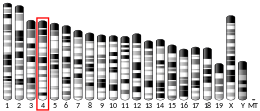 | | Chr. | Chromosome 4 (mouse)[2] |
|---|
| | Band | 4|4 E2 | Start | 148,434,495 bp[2] |
|---|
| End | 148,444,771 bp[2] |
|---|
|
| RNA expression pattern |
|---|
 | | More reference expression data |
|
| Gene ontology |
|---|
| Molecular function | • transferase activity
• antioxidant activity
• GO:0001948 protein binding
• prenyltransferase activity
• transferase activity, transferring alkyl or aryl (other than methyl) groups
|
|---|
| Cellular component | • cytoplasm
• integral component of membrane
• integral component of Golgi membrane
• Golgi apparatus
• endoplasmic reticulum membrane
• membrane
• mitochondrial membranes
• Golgi membrane
• endoplasmic reticulum
• mitochondrion
• cell nucleus
|
|---|
| Biological process | • menaquinone biosynthetic process
• ubiquinone biosynthetic process
• vitamin K biosynthetic process
• vitamin K metabolic process
• cellular oxidant detoxification
• ubiquinone biosynthetic process via 3,4-dihydroxy-5-polyprenylbenzoate
|
|---|
| Sources:Amigo / QuickGO |
|
| Orthologs |
|---|
| Species | Human | Mouse |
|---|
| Entrez | | |
|---|
| Ensembl | | |
|---|
| UniProt | | |
|---|
| RefSeq (mRNA) | |
|---|
NM_013319
NM_001330349
NM_001330350 |
| |
|---|
| RefSeq (protein) | |
|---|
NP_001317278
NP_001317279
NP_037451 |
| |
|---|
| Location (UCSC) | Chr 1: 11.27 – 11.3 Mb | Chr 4: 148.43 – 148.44 Mb |
|---|
| PubMed search | [3] | [4] |
|---|
| Wikidata |
| View/Edit Human | View/Edit Mouse |
|
The enzyme is named for its canonical role in ubiquinone production. Recent evidence suggests that ubiad1 has enzymatic activity in the vitamin K pathway, a role in blood vessel development, and may be involved in oxidative stress pathways.[8][9][10]
Clinical significanceEditMutations of the UBIAD1 gene cause Schnyder crystalline corneal dystrophy.[11][12]>[13]



