Transforming growth factor, beta-induced, 68kDa, also known as TGFBI (initially called BIGH3, BIG-H3), is a protein which in humans is encoded by the TGFBI gene, locus 5q31.[5][6]
| TGFBI |
|---|
 |
| Available structures |
|---|
| PDB | Ortholog search: PDBe RCSB |
|---|
| List of PDB id codes |
|---|
1X3B, 2LTB, 2LTC, 2VXP |
|
|
| Identifiers |
|---|
| Aliases | TGFBI, BIGH3, CDB1, CDG2, CDGG1, CSD, CSD1, CSD2, CSD3, EBMD, LCD1, transforming growth factor beta induced |
|---|
| External IDs | OMIM: 601692 MGI: 99959 HomoloGene: 37294 GeneCards: TGFBI |
|---|
| Gene location (Human) |
|---|
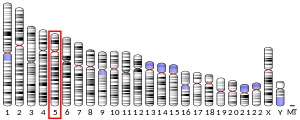 | | Chr. | Chromosome 5 (human)[1] |
|---|
| | Band | 5q31.1 | Start | 136,028,988 bp[1] |
|---|
| End | 136,063,818 bp[1] |
|---|
|
| Gene location (Mouse) |
|---|
 | | Chr. | Chromosome 13 (mouse)[2] |
|---|
| | Band | 13 B1|13 30.09 cM | Start | 56,609,523 bp[2] |
|---|
| End | 56,639,562 bp[2] |
|---|
|
| RNA expression pattern |
|---|
 | | More reference expression data |
|
| Gene ontology |
|---|
| Molecular function | • integrin binding
• GO:0001948 protein binding
• collagen binding
• extracellular matrix binding
• extracellular matrix structural constituent
• cell adhesion molecule binding
|
|---|
| Cellular component | • extracellular matrix
• basement membrane
• trans-Golgi network
• cell membrane
• extracellular exosome
• extracellular
• extracellular region
• collagen-containing extracellular matrix
|
|---|
| Biological process | • cellular protein metabolic process
• negative regulation of cell adhesion
• cellular proliferation
• chondrocyte differentiation
• angiogenesis
• response to stimulus
• visual perception
• cell adhesion
• extracellular matrix organization
|
|---|
| Sources:Amigo / QuickGO |
|
| Orthologs |
|---|
| Species | Human | Mouse |
|---|
| Entrez | | |
|---|
| Ensembl | | |
|---|
| UniProt | | |
|---|
| RefSeq (mRNA) | | |
|---|
| RefSeq (protein) | | |
|---|
| Location (UCSC) | Chr 5: 136.03 – 136.06 Mb | Chr 13: 56.61 – 56.64 Mb |
|---|
| PubMed search | [3] | [4] |
|---|
| Wikidata |
| View/Edit Human | View/Edit Mouse |
|
FunctionEditThis gene encodes an RGD-containing protein that binds to type I, II and IV collagens. The RGD motif is found in many extracellular matrix proteins modulating cell adhesion and serves as a ligand recognition sequence for several integrins. This protein plays a role in cell-collagen interactions and may be involved in endochondrial bone formation in cartilage. The protein is induced by transforming growth factor-beta and acts to inhibit cell adhesion.[5]
Clinical significanceEditMutations of the gene cause several forms of corneal dystrophies.[7][8]

Reis-Bücklers corneal dystrophy. Light microscopy of cornea showing characteristic red stained deposits of mutated TGFBI protein in the superficial corneal stroma. Masson's trichrome stain.



