Sp3 transcription factor, also known as SP3, refers to both a protein and the gene it is encoded by.
| SP3 |
|---|
 |
| Identifiers |
|---|
| Aliases | SP3, SPR2, Sp3 transcription factor |
|---|
| External IDs | OMIM: 601804 MGI: 1277166 HomoloGene: 7952 GeneCards: SP3 |
|---|
| Gene location (Human) |
|---|
 | | Chr. | Chromosome 2 (human)[1] |
|---|
| | Band | 2q31.1 | Start | 173,880,850 bp[1] |
|---|
| End | 173,965,702 bp[1] |
|---|
|
| Gene location (Mouse) |
|---|
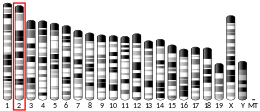 | | Chr. | Chromosome 2 (mouse)[2] |
|---|
| | Band | 2|2 C3 | Start | 72,936,427 bp[2] |
|---|
| End | 72,980,446 bp[2] |
|---|
|
| RNA expression pattern |
|---|
 | | More reference expression data |
|
| Gene ontology |
|---|
| Molecular function | • DNA binding
• chromatin binding
• GO:0001158 core promoter proximal region sequence-specific DNA binding
• metal ion binding
• GO:0001078, GO:0001214, GO:0001206 DNA-binding transcription repressor activity, RNA polymerase II-specific
• GO:0001948 protein binding
• nucleic acid binding
• GO:0001200, GO:0001133, GO:0001201 DNA-binding transcription factor activity, RNA polymerase II-specific
• double-stranded DNA binding
• GO:0001131, GO:0001151, GO:0001130, GO:0001204 DNA-binding transcription factor activity
• RNA polymerase II regulatory region sequence-specific DNA binding
• GO:0000980 RNA polymerase II cis-regulatory region sequence-specific DNA binding
|
|---|
| Cellular component | • PML body
• transcriptional repressor complex
• cell nucleus
• nucleoplasm
• protein-DNA complex
|
|---|
| Biological process | • megakaryocyte differentiation
• regulation of transcription, DNA-templated
• ossification
• lung development
• embryonic placenta development
• in utero embryonic development
• negative regulation of transcription from RNA polymerase II promoter
• monocyte differentiation
• protein sumoylation
• transcription, DNA-templated
• embryonic skeletal system development
• positive regulation of transcription, DNA-templated
• embryonic process involved in female pregnancy
• T cell differentiation
• granulocyte differentiation
• embryonic camera-type eye morphogenesis
• trophectodermal cell differentiation
• enucleate erythrocyte differentiation
• erythrocyte differentiation
• definitive hemopoiesis
• liver development
• B cell differentiation
• negative regulation of transcription, DNA-templated
• positive regulation of transcription from RNA polymerase II promoter
• natural killer cell differentiation
• regulation of transcription from RNA polymerase II promoter
|
|---|
| Sources:Amigo / QuickGO |
|
| Orthologs |
|---|
| Species | Human | Mouse |
|---|
| Entrez | | |
|---|
| Ensembl | | |
|---|
| UniProt | | |
|---|
| RefSeq (mRNA) | |
|---|
NM_003111
NM_001017371
NM_001172712 |
| |
|---|
NM_001018042
NM_001098425
NM_011450 |
|
|---|
| RefSeq (protein) | |
|---|
NP_001017371
NP_001166183
NP_003102
NP_003102.1 |
| |
|---|
| Location (UCSC) | Chr 2: 173.88 – 173.97 Mb | Chr 2: 72.94 – 72.98 Mb |
|---|
| PubMed search | [3] | [4] |
|---|
| Wikidata |
| View/Edit Human | View/Edit Mouse |
|
This gene belongs to a family of Sp1 related genes that encode transcription factors that regulate transcription by binding to consensus GC- and GT-box regulatory elements in target genes. This protein contains a zinc finger DNA-binding domain and several transactivation domains, and has been reported to function as a bifunctional transcription factor that either stimulates or represses the transcription of numerous genes. Transcript variants encoding different isoforms have been described for this gene, and one has been reported to initiate translation from a non-AUG (AUA) start codon. Additional isoforms, resulting from the use of alternate downstream translation initiation sites, have also been noted.[5]
InteractionsEditSp3 transcription factor has been shown to interact with Histone deacetylase 2,[6][7] PIAS1,[8] E2F1[9] and GABPA.[10]


