Tyrosine-protein kinase transmembrane receptor ROR1, also known as neurotrophic tyrosine kinase, receptor-related 1 (NTRKR1), is an enzyme that in humans is encoded by the ROR1 gene.[5][6][7] ROR1 is a member of the receptor tyrosine kinase-like orphan receptor (ROR) family.
| ROR1 |
|---|
|
| Identifiers |
|---|
| Aliases | ROR1, NTRKR1, dJ537F10.1, receptor tyrosine kinase-like orphan receptor 1, receptor tyrosine kinase like orphan receptor 1 |
|---|
| External IDs | OMIM: 602336 MGI: 1347520 HomoloGene: 3675 GeneCards: ROR1 |
|---|
| Gene location (Human) |
|---|
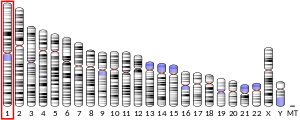 | | Chr. | Chromosome 1 (human)[1] |
|---|
| | Band | 1p31.3 | Start | 63,774,017 bp[1] |
|---|
| End | 64,181,498 bp[1] |
|---|
|
| Gene location (Mouse) |
|---|
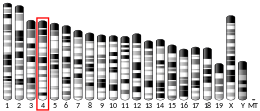 | | Chr. | Chromosome 4 (mouse)[2] |
|---|
| | Band | 4 C6|4 45.71 cM | Start | 100,095,791 bp[2] |
|---|
| End | 100,444,765 bp[2] |
|---|
|
| Gene ontology |
|---|
| Molecular function | • transmembrane receptor protein tyrosine kinase activity
• nucleotide binding
• GO:0001948 protein binding
• protein kinase activity
• Wnt-protein binding
• kinase activity
• ATP binding
• transferase activity
• coreceptor activity involved in Wnt signaling pathway, planar cell polarity pathway
• Wnt-activated receptor activity
• receptor tyrosine kinase
• transmembrane signaling receptor activity
|
|---|
| Cellular component | • receptor complex
• integral component of plasma membrane
• integral component of membrane
• membrane
• stress fiber
• cytoplasm
• cell surface
• cell membrane
• axon terminus
• axon
• cell projection
|
|---|
| Biological process | • phosphorylation
• protein phosphorylation
• Wnt signaling pathway
• transmembrane receptor protein tyrosine kinase signaling pathway
• Wnt signaling pathway, planar cell polarity pathway
• peptidyl-tyrosine phosphorylation
• astrocyte development
• sensory perception of sound
• positive regulation of I-kappaB kinase/NF-kappaB signaling
• inner ear development
• positive regulation of NF-kappaB transcription factor activity
• negative regulation of signal transduction
• cell differentiation
• negative regulation of apoptotic process
• positive regulation of ERK1 and ERK2 cascade
• anatomical structure development
|
|---|
| Sources:Amigo / QuickGO |
|
| Orthologs |
|---|
| Species | Human | Mouse |
|---|
| Entrez | | |
|---|
| Ensembl | | |
|---|
| UniProt | | |
|---|
| RefSeq (mRNA) | | |
|---|
| RefSeq (protein) | | |
|---|
| Location (UCSC) | Chr 1: 63.77 – 64.18 Mb | Chr 4: 100.1 – 100.44 Mb |
|---|
| PubMed search | [3] | [4] |
|---|
| Wikidata |
| View/Edit Human | View/Edit Mouse |
|
FunctionEditThe protein encoded by this gene is a receptor tyrosine kinase that modulates neurite growth in the central nervous system. It is a type I membrane protein and belongs to the ROR subfamily of cell surface receptors.[5] ROR1 is currently under investigation for its role in the metastasis of cancer cells.[8]
ROR1 has recently been shown to be expressed on ovarian cancer stem cell, on which it seems to play a functional role in promoting migration/invasion or spheroid formation in vitro and tumor engraftment in immune-deficient mice. Treatment with a humanized mAb specific for ROR1 (UC-961) could inhibit the capacity of ovarian cancer cells to migrate, form spheroids, or engraft immune-deficient mice. Moreover, such treatment inhibited the growth of tumor xenografts, which in turn had a reduced capacity to engraft immune-deficient mice and were relatively depleted of cells with features of CSC, suggesting that treatment with UC-961 could impair CSC renewal. Collectively, these studies indicate that ovarian CSCs express ROR1, which may be targeted for anti-CSC therapy.[9]



