Regulator of G protein signaling 4 also known as RGP4 is a protein that in humans is encoded by the RGS4 gene. RGP4 regulates G protein signaling.[5]
| RGS4 |
|---|
 |
| Identifiers |
|---|
| Aliases | RGS4, Rgs4, AA004315, AA597169, ESTM48, ESTM50, RGP4, SCZD9, regulator of G-protein signaling 4, regulator of G protein signaling 4 |
|---|
| External IDs | OMIM: 602516 MGI: 108409 HomoloGene: 4100 GeneCards: RGS4 |
|---|
| Gene location (Human) |
|---|
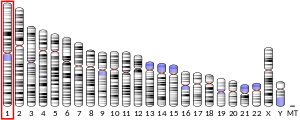 | | Chr. | Chromosome 1 (human)[1] |
|---|
| | Band | 1q23.3 | Start | 163,068,775 bp[1] |
|---|
| End | 163,076,802 bp[1] |
|---|
|
| Gene location (Mouse) |
|---|
 | | Chr. | Chromosome 1 (mouse)[2] |
|---|
| | Band | 1 H2.3|1 76.84 cM | Start | 169,741,477 bp[2] |
|---|
| End | 169,747,642 bp[2] |
|---|
|
| RNA expression pattern |
|---|


 | | More reference expression data |
|
| Gene ontology |
|---|
| Molecular function | • G-protein alpha-subunit binding
• calmodulin binding
• GO:0005097, GO:0005099, GO:0005100 GTPase activator activity
• GTPase activity
|
|---|
| Cellular component | • cytoplasm
• cytosol
• cell membrane
• membrane
• cell nucleus
• macromolecular complex
|
|---|
| Biological process | • inactivation of MAPK activity
• GO:0032320, GO:0032321, GO:0032855, GO:0043089, GO:0032854 positive regulation of GTPase activity
• negative regulation of signal transduction
• negative regulation of G-protein coupled receptor protein signaling pathway
• regulation of G-protein coupled receptor protein signaling pathway
• G-protein coupled receptor signaling pathway
• response to amphetamine
• brain development
• positive regulation of heart rate
• response to cocaine
• response to morphine
• response to ethanol
• regulation of calcium ion transport
• negative regulation of dopamine receptor signaling pathway
• negative regulation of cell growth involved in cardiac muscle cell development
• regulation of actin filament organization
• negative regulation of glycine import
• regulation of potassium ion transmembrane transport
• negative regulation of potassium ion transmembrane transport
• dorsal root ganglion development
• positive regulation of excitatory postsynaptic potential
|
|---|
| Sources:Amigo / QuickGO |
|
| Orthologs |
|---|
| Species | Human | Mouse |
|---|
| Entrez | | |
|---|
| Ensembl | | |
|---|
| UniProt | | |
|---|
| RefSeq (mRNA) | |
|---|
NM_001102445
NM_001113380
NM_001113381
NM_005613 |
| |
|---|
| RefSeq (protein) | |
|---|
NP_001095915
NP_001106851
NP_001106852
NP_005604
NP_005604.1 |
| |
|---|
| Location (UCSC) | Chr 1: 163.07 – 163.08 Mb | Chr 1: 169.74 – 169.75 Mb |
|---|
| PubMed search | [3] | [4] |
|---|
| Wikidata |
| View/Edit Human | View/Edit Mouse |
|
FunctionEditRegulator of G protein signalling (RGS) family members are regulatory molecules that act as GTPase activating proteins (GAPs) for G alpha subunits of heterotrimeric G proteins.[6] RGS proteins are able to deactivate G protein subunits of the Gi alpha, Go alpha and Gq alpha subtypes. They drive G proteins into their inactive GDP-bound forms. Regulator of G protein signaling 4 belongs to this family. All RGS proteins share a conserved 120-amino acid sequence termed the RGS domain which conveys GAP activity.[7] Regulator of G protein signaling 4 protein is 37% identical to RGS1 and 97% identical to rat Rgs4. This protein negatively regulates signaling upstream or at the level of the heterotrimeric G protein and is localized in the cytoplasm.[5]
Clinical significanceEditA number of studies associate the RGS4 gene with schizophrenia,[8][9][10][11] while some fail to detect an association.[12]
RGS4 is also of interest as one of the three main RGS proteins (along with RGS9 and RGS17) involved in terminating signalling by the mu opioid receptor,[13] and may be important in the development of tolerance to opioid drugs.[14][15][16][17][18]



