Receptor-type tyrosine-protein phosphatase F is an enzyme that in humans is encoded by the PTPRF gene.[5][6]
| PTPRF |
|---|
 |
| Available structures |
|---|
| PDB | Ortholog search: PDBe RCSB |
|---|
| List of PDB id codes |
|---|
1LAR, 2DJU, 2EDX, 2EDY, 2YD5, 2YD8, 4N5U, 2DN7 |
|
|
| Identifiers |
|---|
| Aliases | PTPRF, LAR, BNAH2, protein tyrosine phosphatase, receptor type F, protein tyrosine phosphatase receptor type F |
|---|
| External IDs | OMIM: 179590 MGI: 102695 HomoloGene: 20623 GeneCards: PTPRF |
|---|
| Gene location (Human) |
|---|
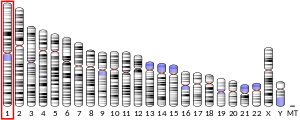 | | Chr. | Chromosome 1 (human)[1] |
|---|
| | Band | 1p34.2 | Start | 43,525,187 bp[1] |
|---|
| End | 43,623,666 bp[1] |
|---|
|
| Gene location (Mouse) |
|---|
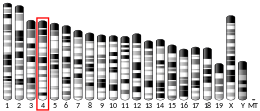 | | Chr. | Chromosome 4 (mouse)[2] |
|---|
| | Band | 4|4 D2.1 | Start | 118,208,213 bp[2] |
|---|
| End | 118,291,405 bp[2] |
|---|
|
| RNA expression pattern |
|---|


 | | More reference expression data |
|
| Gene ontology |
|---|
| Molecular function | • chondroitin sulfate proteoglycan binding
• heparin binding
• phosphoprotein phosphatase activity
• phosphatase activity
• GO:0032403 macromolecular complex binding
• protein tyrosine phosphatase activity
• transmembrane receptor protein tyrosine phosphatase activity
• hydrolase activity
• cell adhesion molecule binding
|
|---|
| Cellular component | • integral component of membrane
• membrane
• integral component of plasma membrane
• neuronal cell body
• neuron projection
• extracellular exosome
• cell membrane
|
|---|
| Biological process | • neuron projection regeneration
• regulation of axon regeneration
• negative regulation of receptor binding
• regulation of neuron projection development
• protein dephosphorylation
• transmembrane receptor protein tyrosine phosphatase signaling pathway
• cell adhesion
• peptidyl-tyrosine dephosphorylation
• cell migration
• dephosphorylation
• synaptic membrane adhesion
|
|---|
| Sources:Amigo / QuickGO |
|
| Orthologs |
|---|
| Species | Human | Mouse |
|---|
| Entrez | | |
|---|
| Ensembl | | |
|---|
| UniProt | | |
|---|
| RefSeq (mRNA) | NM_002840
NM_130440
NM_001329137
NM_001329138
NM_001329139
|
|---|
NM_001329140 |
| |
|---|
| RefSeq (protein) | NP_001316066
NP_001316067
NP_001316068
NP_001316069
NP_002831
|
|---|
NP_569707 |
| |
|---|
| Location (UCSC) | Chr 1: 43.53 – 43.62 Mb | Chr 4: 118.21 – 118.29 Mb |
|---|
| PubMed search | [3] | [4] |
|---|
| Wikidata |
| View/Edit Human | View/Edit Mouse |
|
The protein encoded by this gene is a member of the protein tyrosine phosphatase (PTP) family. PTPs are known to be signaling molecules that regulate a variety of cellular processes including cell growth, differentiation, mitotic cycle, and oncogenic transformation. This PTP possesses an extracellular region, a single transmembrane region, and two tandem intracytoplasmic catalytic domains, and thus represents a receptor-type PTP. The extracellular region contains three Ig-like domains, and nine non-Ig like domains similar to that of neural cell adhesion molecule. This PTP was shown to function in the regulation of epithelial cell–cell contacts at adherens junctions, as well as in the control of beta-catenin signaling. An increased expression level of this protein was found in the insulin-responsive tissue of obese, insulin-resistant individuals, and may contribute to the pathogenesis of insulin resistance. Two alternatively spliced transcript variants of this gene, which encode distinct proteins, have been reported.[6]
InteractionsEditPTPRF has been shown to interact with Beta-catenin[7][8] and liprin-alpha-1.[9][10][11]



