Presenilin-2 is a protein that (in humans) is encoded by the PSEN2 gene.[5]
| PSEN2 |
|---|
|
| Identifiers |
|---|
| Aliases | PSEN2, AD3L, AD4, CMD1V, PS2, STM2, presenilin 2 |
|---|
| External IDs | OMIM: 600759 MGI: 109284 HomoloGene: 386 GeneCards: PSEN2 |
|---|
| Gene location (Human) |
|---|
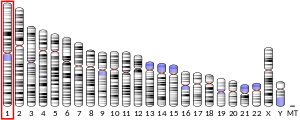 | | Chr. | Chromosome 1 (human)[1] |
|---|
| | Band | 1q42.13 | Start | 226,870,184 bp[1] |
|---|
| End | 226,896,105 bp[1] |
|---|
|
| Gene location (Mouse) |
|---|
 | | Chr. | Chromosome 1 (mouse)[2] |
|---|
| | Band | 1 H4|1 84.19 cM | Start | 180,227,004 bp[2] |
|---|
| End | 180,263,438 bp[2] |
|---|
|
| RNA expression pattern |
|---|
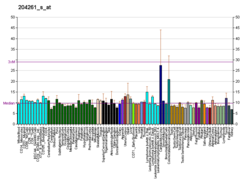
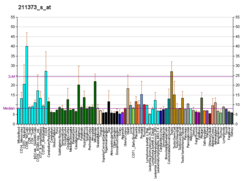
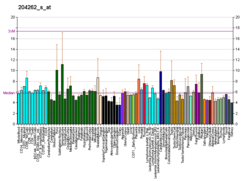 | | More reference expression data |
|
| Gene ontology |
|---|
| Molecular function | • endopeptidase activity
• peptidase activity
• GO:0001948 protein binding
• hydrolase activity
• aspartic endopeptidase activity, intramembrane cleaving
• aspartic-type endopeptidase activity
|
|---|
| Cellular component | • integral component of membrane
• centrosome
• Golgi apparatus
• endoplasmic reticulum membrane
• membrane
• Golgi membrane
• cell membrane
• integral component of plasma membrane
• neuronal cell body
• nuclear inner membrane
• Z disc
• endoplasmic reticulum
• perinuclear region of cytoplasm
• kinetochore
• mitochondrial inner membrane
• lysosomal membrane
• cell cortex
• cell surface
• axon
• growth cone
• neuromuscular junction
• ciliary rootlet
• dendritic shaft
• membrane raft
• cell nucleus
• early endosome
• synaptic vesicle
• apical plasma membrane
• macromolecular complex
• synaptic membrane
• integral component of presynaptic membrane
• intracellular
|
|---|
| Biological process | • Notch signaling pathway
• GO:0007243 intracellular signal transduction
• response to hypoxia
• ephrin receptor signaling pathway
• protein processing
• GO:0048554 positive regulation of catalytic activity
• negative regulation of apoptotic process
• amyloid-beta metabolic process
• proteolysis
• membrane protein ectodomain proteolysis
• membrane protein intracellular domain proteolysis
• positive regulation of apoptotic process
• Notch receptor processing
• calcium ion transport
• amyloid precursor protein catabolic process
• Notch receptor processing, ligand-dependent
• regulation of calcium import into the mitochondrion
• mitochondrion-endoplasmic reticulum membrane tethering
|
|---|
| Sources:Amigo / QuickGO |
|
| Orthologs |
|---|
| Species | Human | Mouse |
|---|
| Entrez | | |
|---|
| Ensembl | | |
|---|
| UniProt | | |
|---|
| RefSeq (mRNA) | | |
|---|
| RefSeq (protein) | | |
|---|
| Location (UCSC) | Chr 1: 226.87 – 226.9 Mb | Chr 1: 180.23 – 180.26 Mb |
|---|
| PubMed search | [3] | [4] |
|---|
| Wikidata |
| View/Edit Human | View/Edit Mouse |
|
FunctionEditAlzheimer's disease (AD) patients with an inherited form of the disease carry mutations in the presenilin proteins (PSEN1; PSEN2) or the amyloid precursor protein (APP). These disease-linked mutations result in increased production of the longer form of amyloid-beta (main component of amyloid deposits found in AD brains). Presenilins are postulated to regulate APP processing through their effects on gamma-secretase, an enzyme that cleaves APP. Also, it is thought that the presenilins are involved in the cleavage of the Notch receptor, such that they either directly regulate gamma-secretase activity or themselves are protease enzymes. Two alternative transcripts of PSEN2 have been identified.[6]
In melanocytic cells PSEN2 gene expression may be regulated by MITF.[7]



