Plexin-A2 is a protein that in humans is coded by the PLXNA2 gene.[5][6]
| PLXNA2 |
|---|
|
| Available structures |
|---|
| PDB | Ortholog search: PDBe RCSB |
|---|
|
|
| Identifiers |
|---|
| Aliases | PLXNA2, OCT, PLXN2, plexin A2 |
|---|
| External IDs | OMIM: 601054 MGI: 107684 HomoloGene: 56427 GeneCards: PLXNA2 |
|---|
| Gene location (Human) |
|---|
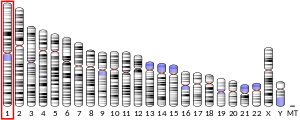 | | Chr. | Chromosome 1 (human)[1] |
|---|
| | Band | 1q32.2 | Start | 208,022,242 bp[1] |
|---|
| End | 208,244,384 bp[1] |
|---|
|
| Gene location (Mouse) |
|---|
 | | Chr. | Chromosome 1 (mouse)[2] |
|---|
| | Band | 1|1 H6 | Start | 194,618,218 bp[2] |
|---|
| End | 194,816,869 bp[2] |
|---|
|
| RNA expression pattern |
|---|
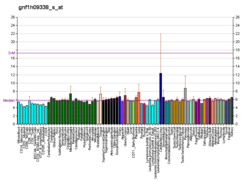

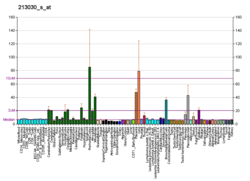 | | More reference expression data |
|
| Gene ontology |
|---|
| Molecular function | • GO:0001948 protein binding
• semaphorin receptor activity
• identical protein binding
|
|---|
| Cellular component | • integral component of membrane
• cell membrane
• semaphorin receptor complex
• membrane
• integral component of plasma membrane
|
|---|
| Biological process | • somitogenesis
• cell surface receptor signaling pathway
• regulation of axon extension involved in axon guidance
• cerebellar granule cell precursor tangential migration
• branchiomotor neuron axon guidance
• limb bud formation
• neural tube development
• semaphorin-plexin signaling pathway
• signal transduction
• pharyngeal system development
• centrosome localization
• regulation of cell migration
• negative regulation of cell adhesion
• regulation of cell shape
• GO:0043087, GO:0032313, GO:0032319, GO:0032314, GO:0043088 regulation of GTPase activity
• positive regulation of axonogenesis
• semaphorin-plexin signaling pathway involved in axon guidance
|
|---|
| Sources:Amigo / QuickGO |
|
| Orthologs |
|---|
| Species | Human | Mouse |
|---|
| Entrez | | |
|---|
| Ensembl | | |
|---|
| UniProt | | |
|---|
| RefSeq (mRNA) | | |
|---|
| RefSeq (protein) | | |
|---|
| Location (UCSC) | Chr 1: 208.02 – 208.24 Mb | Chr 1: 194.62 – 194.82 Mb |
|---|
| PubMed search | [3] | [4] |
|---|
| Wikidata |
| View/Edit Human | View/Edit Mouse |
|
This gene encodes a member of the plexin-A family of semaphorin co-receptors. Semaphorins are a large family of secreted or membrane-bound proteins that mediate repulsive effects on axon pathfinding during nervous system development. A subset of semaphorins are recognized by plexin-A/neuropilin transmembrane receptor complexes, triggering a cellular signal transduction cascade that leads to axon repulsion. This plexin-A family member is thought to transduce signals from semaphorin-3A and -3C.[6]
In some studies, the PLXNA2 gene is associated with schizophrenia.[7] and anxiety.[8]



