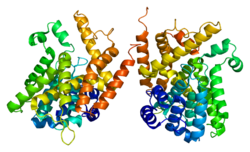
cAMP-specific 3',5'-cyclic phosphodiesterase 4B is an enzyme that in humans is encoded by the PDE4B gene.[5]
| PDE4B |
|---|
 |
| Available structures |
|---|
| PDB | Human UniProt search: PDBe RCSB |
|---|
| List of PDB id codes |
|---|
1F0J, 1RO6, 1RO9, 1ROR, 1TB5, 1XLX, 1XLZ, 1XM4, 1XM6, 1XMU, 1XMY, 1XN0, 1XOS, 1XOT, 1Y2H, 1Y2J, 2CHM, 2QYL, 3D3P, 3FRG, 3G45, 3GWT, 3HC8, 3HDZ, 3HMV, 3KKT, 3LY2, 3O0J, 3O56, 3O57, 3W5E, 3WD9, 4KP6, 4MYQ, 4NW7, 4WZI, 4X0F |
|
|
| Identifiers |
|---|
| Aliases | PDE4B, DPDE4, PDEIVB, phosphodiesterase 4B |
|---|
| External IDs | OMIM: 600127 MGI: 99557 HomoloGene: 1953 GeneCards: PDE4B |
|---|
| Gene location (Human) |
|---|
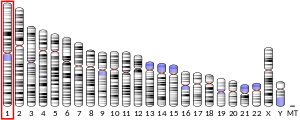 | | Chr. | Chromosome 1 (human)[1] |
|---|
| | Band | 1p31.3 | Start | 65,792,514 bp[1] |
|---|
| End | 66,374,579 bp[1] |
|---|
|
| Gene location (Mouse) |
|---|
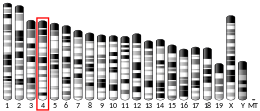 | | Chr. | Chromosome 4 (mouse)[2] |
|---|
| | Band | 4 C6|4 46.99 cM | Start | 102,087,543 bp[2] |
|---|
| End | 102,607,259 bp[2] |
|---|
|
| RNA expression pattern |
|---|


 | | More reference expression data |
|
| Gene ontology |
|---|
| Molecular function | • metal ion binding
• 3',5'-cyclic-nucleotide phosphodiesterase activity
• hydrolase activity
• cAMP binding
• gamma-tubulin binding
• ion channel binding
• phosphoric diester hydrolase activity
• 3',5'-cyclic-AMP phosphodiesterase activity
• GO:0001948 protein binding
|
|---|
| Cellular component | • voltage-gated calcium channel complex
• gamma-tubulin complex
• cell periphery
• cytosol
• GO:0097483, GO:0097481 postsynaptic density
• dendritic spine
• membrane
• centrosome
• Z disc
• excitatory synapse
• synaptic vesicle
|
|---|
| Biological process | • regulation of high voltage-gated calcium channel activity
• neutrophil homeostasis
• cellular response to drug
• regulation of cardiac muscle cell contraction
• positive regulation of interferon-gamma production
• signal transduction
• cellular response to lipopolysaccharide
• positive regulation of interleukin-2 production
• leukocyte migration
• negative regulation of relaxation of cardiac muscle
• cellular response to epinephrine stimulus
• T cell receptor signaling pathway
• neutrophil chemotaxis
• cAMP catabolic process
• G-protein coupled receptor signaling pathway
|
|---|
| Sources:Amigo / QuickGO |
|
| Orthologs |
|---|
| Species | Human | Mouse |
|---|
| Entrez | | |
|---|
| Ensembl | | |
|---|
| UniProt | | |
|---|
| RefSeq (mRNA) | NM_001037339
NM_001037340
NM_001037341
NM_001297440
NM_001297441
|
|---|
NM_001297442
NM_002600 |
| NM_001177980
NM_001177981
NM_001177982
NM_001177983
NM_019840
|
|---|
NM_001374780 |
|
|---|
| RefSeq (protein) | NP_001032416
NP_001032417
NP_001032418
NP_001284369
NP_001284370
|
|---|
NP_001284371
NP_002591
NP_001032418.1
NP_002591.2 |
| |
|---|
| Location (UCSC) | Chr 1: 65.79 – 66.37 Mb | Chr 4: 102.09 – 102.61 Mb |
|---|
| PubMed search | [3] | [4] |
|---|
| Wikidata |
| View/Edit Human | View/Edit Mouse |
|
This gene is a member of the type IV, cyclic AMP (cAMP)-specific, cyclic nucleotide phosphodiesterase (PDE) family. Cyclic nucleotides are important second messengers that regulate and mediate a number of cellular responses to extracellular signals, such as hormones, light, and neurotransmitters. The cyclic nucleotide phosphodiesterases (PDEs) regulate the cellular concentrations of cyclic nucleotides and thereby play a role in signal transduction. This gene encodes a protein that specifically hydrolyzes cAMP. Alternate transcriptional splice variants, encoding different isoforms, have been characterized.[5][6]
Clinical relevanceEditAltered activity of this protein has been associated with schizophrenia and bipolar disorder.[5] PDE4B is believed to be the PDE4 subtype involved in the antipsychotic effects of PDE4 inhibitors such as rolipram.[7] PDE4B is involved in dopamine-associated and stress-related behaviours.[8] It has also recently been found to modulate cognition, as reduction in PDE4B activity improves memory and long-term plasticity in mouse models, possibly supporting further therapeutic applications.[9]
InhibitorsEditAN2728, a boron-containing drug candidate that as of 2015 was under development by Anacor Pharmaceuticals for the topical treatment of psoriasis and atopic dermatitis (atopic eczema).[10][11][12] mainly acting on PDE4B.[12]



