Nidogen-1 (NID-1), formerly known as entactin, is a protein that in humans is encoded by the NID1 gene.[5][6] Both nidogen-1 and nidogen-2 are essential components of the basement membrane alongside other components such as type IV collagen, proteoglycans (heparan sulfate and glycosaminoglycans), laminin[7] and fibronectin.[8]
| NID1 |
|---|
 |
| Available structures |
|---|
| PDB | Ortholog search: PDBe RCSB |
|---|
|
|
| Identifiers |
|---|
| Aliases | NID1, NID, nidogen 1 |
|---|
| External IDs | OMIM: 131390 MGI: 97342 HomoloGene: 1878 GeneCards: NID1 |
|---|
| Gene location (Human) |
|---|
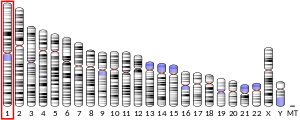 | | Chr. | Chromosome 1 (human)[1] |
|---|
| | Band | 1q42.3 | Start | 235,975,830 bp[1] |
|---|
| End | 236,065,109 bp[1] |
|---|
|
| Gene location (Mouse) |
|---|
 | | Chr. | Chromosome 13 (mouse)[2] |
|---|
| | Band | 13 A1|13 5.26 cM | Start | 13,437,551 bp[2] |
|---|
| End | 13,512,269 bp[2] |
|---|
|
| RNA expression pattern |
|---|
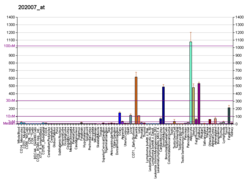
 | | More reference expression data |
|
| Gene ontology |
|---|
| Molecular function | • laminin-1 binding
• calcium ion binding
• laminin binding
• collagen binding
• extracellular matrix binding
• proteoglycan binding
• extracellular matrix structural constituent
|
|---|
| Cellular component | • extracellular matrix
• extracellular region
• basement membrane
• extracellular exosome
• cell periphery
• extracellular
• collagen-containing extracellular matrix
|
|---|
| Biological process | • cell-matrix adhesion
• extracellular matrix disassembly
• extracellular matrix organization
• cell adhesion
• glomerular basement membrane development
• basement membrane organization
• positive regulation of cell-substrate adhesion
|
|---|
| Sources:Amigo / QuickGO |
|
| Orthologs |
|---|
| Species | Human | Mouse |
|---|
| Entrez | | |
|---|
| Ensembl | | |
|---|
| UniProt | | |
|---|
| RefSeq (mRNA) | | |
|---|
| RefSeq (protein) | | |
|---|
| Location (UCSC) | Chr 1: 235.98 – 236.07 Mb | Chr 13: 13.44 – 13.51 Mb |
|---|
| PubMed search | [3] | [4] |
|---|
| Wikidata |
| View/Edit Human | View/Edit Mouse |
|
FunctionEditNidogen-1 is a member of the nidogen family of basement membrane glycoproteins. The protein interacts with several other components of basement membranes. Structurally it (along with perlecan) connects the networks formed by collagens and laminins to each other.[9] It may also play a role in cell interactions with the extracellular matrix.[10][11]
Clinical significanceEditMutations in NID1 cause autosomal dominant Dandy–Walker malformation with occipital encephalocele (ADDWOC).[12][13]
InteractionsEditNidogen-1 has been shown to interact with FBLN1.[14][15][16]



