Nuclear factor NF-kappa-B p105 subunit is a protein that in humans is encoded by the NFKB1 gene.[5]
| NFKB1 |
|---|
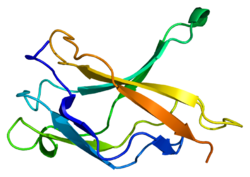 |
| Available structures |
|---|
| PDB | Ortholog search: PDBe RCSB |
|---|
| List of PDB id codes |
|---|
1MDI, 1MDJ, 1MDK, 1NFI, 1SVC, 2DBF, 2O61, 3GUT |
|
|
| Identifiers |
|---|
| Aliases | NFKB1, EBP-1, KBF1, NF-kB1, NF-kappa-B, NF-kappaB, NFKB-p105, NFKB-p50, NFkappaB, p105, p50, CVID12, nuclear factor kappa B subunit 1, NF-kappa-B1, NF-kB, NF-kappabeta |
|---|
| External IDs | OMIM: 164011 MGI: 97312 HomoloGene: 2971 GeneCards: NFKB1 |
|---|
| Gene location (Human) |
|---|
 | | Chr. | Chromosome 4 (human)[1] |
|---|
| | Band | 4q24 | Start | 102,501,331 bp[1] |
|---|
| End | 102,617,302 bp[1] |
|---|
|
| Gene location (Mouse) |
|---|
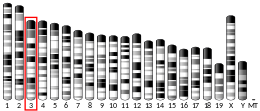 | | Chr. | Chromosome 3 (mouse)[2] |
|---|
| | Band | 3 G3|3 62.82 cM | Start | 135,584,655 bp[2] |
|---|
| End | 135,691,547 bp[2] |
|---|
|
| RNA expression pattern |
|---|
 | | More reference expression data |
|
| Gene ontology |
|---|
| Molecular function | • GO:0001131, GO:0001151, GO:0001130, GO:0001204 DNA-binding transcription factor activity
• RNA polymerase II regulatory region sequence-specific DNA binding
• transcription factor binding
• GO:0001077, GO:0001212, GO:0001213, GO:0001211, GO:0001205 DNA-binding transcription activator activity, RNA polymerase II-specific
• GO:0001078, GO:0001214, GO:0001206 DNA-binding transcription repressor activity, RNA polymerase II-specific
• GO:0000980 RNA polymerase II cis-regulatory region sequence-specific DNA binding
• protein homodimerization activity
• chromatin binding
• GO:0001948 protein binding
• DNA binding
• sequence-specific DNA binding
• actinin binding
• identical protein binding
• transcription regulatory region sequence-specific DNA binding
• protein heterodimerization activity
• GO:0001200, GO:0001133, GO:0001201 DNA-binding transcription factor activity, RNA polymerase II-specific
|
|---|
| Cellular component | • cytoplasm
• mitochondrion
• cell nucleus
• I-kappaB/NF-kappaB complex
• nucleoplasm
• extracellular region
• cytosol
• secretory granule lumen
• specific granule lumen
|
|---|
| Biological process | • negative regulation of cellular protein metabolic process
• cellular response to interleukin-6
• positive regulation of canonical Wnt signaling pathway
• regulation of transcription from RNA polymerase II promoter
• transcription from RNA polymerase II promoter
• negative regulation of vitamin D biosynthetic process
• Fc-epsilon receptor signaling pathway
• cellular response to mechanical stimulus
• NIK/NF-kappaB signaling
• stress-activated MAPK cascade
• negative regulation of inflammatory response
• apoptotic process
• response to muscle stretch
• regulation of transcription, DNA-templated
• stimulatory C-type lectin receptor signaling pathway
• transcription, DNA-templated
• positive regulation of transcription, DNA-templated
• negative regulation of calcidiol 1-monooxygenase activity
• positive regulation of hyaluronan biosynthetic process
• membrane protein intracellular domain proteolysis
• inflammatory response
• I-kappaB kinase/NF-kappaB signaling
• positive regulation of miRNA metabolic process
• cellular response to nicotine
• negative regulation of transcription from RNA polymerase II promoter
• positive regulation of macrophage derived foam cell differentiation
• positive regulation of NF-kappaB transcription factor activity
• negative regulation of cholesterol transport
• negative regulation of transcription, DNA-templated
• negative regulation of cytokine production
• positive regulation of lipid storage
• cellular response to dsRNA
• T cell receptor signaling pathway
• positive regulation of type I interferon production
• positive regulation of transcription from RNA polymerase II promoter
• signal transduction
• cellular response to lipopolysaccharide
• cellular response to interleukin-1
• innate immune system
• negative regulation of apoptotic process
• negative regulation of gene expression
• neutrophil degranulation
• cellular response to tumor necrosis factor
• cellular response to angiotensin
• interleukin-1-mediated signaling pathway
|
|---|
| Sources:Amigo / QuickGO |
|
| Orthologs |
|---|
| Species | Human | Mouse |
|---|
| Entrez | | |
|---|
| Ensembl | | |
|---|
| UniProt | | |
|---|
| RefSeq (mRNA) | NM_001165412
NM_003998
NM_001319226
NM_001382625
NM_001382626
|
|---|
NM_001382627
NM_001382628 |
| |
|---|
| RefSeq (protein) | NP_001158884
NP_001306155
NP_003989
NP_001369554
NP_001369555
|
|---|
NP_001369556
NP_001369557
NP_001158884.1
NP_001306155.1 |
| |
|---|
| Location (UCSC) | Chr 4: 102.5 – 102.62 Mb | Chr 3: 135.58 – 135.69 Mb |
|---|
| PubMed search | [3] | [4] |
|---|
| Wikidata |
| View/Edit Human | View/Edit Mouse |
|
This gene encodes a 105 kD protein which can undergo cotranslational processing by the 26S proteasome to produce a 50 kD protein. The 105 kD protein is a Rel protein-specific transcription inhibitor and the 50 kD protein is a DNA binding subunit of the NF-kappaB (NF-κB) protein complex. NF-κB is a transcription factor that is activated by various intra- and extra-cellular stimuli such as cytokines, oxidant-free radicals, ultraviolet irradiation, and bacterial or viral products. Activated NF-κB translocates into the nucleus and stimulates the expression of genes involved in a wide variety of biological functions; over 200 known genes are targets of NF-κB in various cell types, under specific conditions. Inappropriate activation of NF-κB has been associated with a number of inflammatory diseases while persistent inhibition of NF-κB leads to inappropriate immune cell development or delayed cell growth.[6]
Model organismsEditNfkb1 knockout mouse phenotype| Characteristic | Phenotype |
|---|
| Homozygote viability | Normal |
| Fertility | Normal |
| Body weight | Normal |
| Anxiety | Normal |
| Neurological assessment | Normal |
| Grip strength | Normal |
| Hot plate | Normal |
| Dysmorphology | Normal |
| Indirect calorimetry | Abnormal |
| Glucose tolerance test | Normal |
| Auditory brainstem response | Normal |
| DEXA | Normal |
| Radiography | Normal |
| Body temperature | Normal |
| Eye morphology | Normal[7] |
| Clinical chemistry | Abnormal[8] |
| Plasma immunoglobulins | Abnormal |
| Haematology | Abnormal[9] |
| Peripheral blood lymphocytes | Abnormal[10] |
| Micronucleus test | Normal |
| Heart weight | Normal |
| Tail epidermis wholemount | Normal |
| Skin Histopathology | Normal |
| Brain histopathology | Normal |
| Salmonella infection | Abnormal[11] |
| All tests and analysis from[12][13] |
Model organisms have been used in the study of NFKB1 function. A conditional knockout mouse line, called Nfkb1tm1a(KOMP)Wtsi[14][15] was generated as part of the International Knockout Mouse Consortium program — a high-throughput mutagenesis project to generate and distribute animal models of disease to interested scientists.[16][17][18]
Male and female animals underwent a standardized phenotypic screen to determine the effects of deletion.[12][19] Twenty five tests were carried out on mutant mice and six significant abnormalities were observed.[12] Female homozygotes had a decreased respiratory quotient, increased circulating alkaline phosphatase level and increased leukocyte cell number. Male homozygotes showed an increased susceptibility to Salmonella infection, while homozygotes of both sex had decreased IgG1 and decreased regulatory T cell and NK cell numbers.[12]


