Condensin-2 complex subunit G2 (CAP-G2) also known as chromosome-associated protein G2 (CAP-G2) or leucine zipper protein 5 (LUZP5) is a protein that in humans is encoded by the NCAPG2 gene.[5][6] CAP-G2 is a subunit of condensin II, a large protein complex involved in chromosome condensation. It interacts with PLK1 through its C-terminal region during mitosis[7]
| NCAPG2 |
|---|
|
| Identifiers |
|---|
| Aliases | NCAPG2, CAP-G2, CAPG2, LUZP5, MTB, hCAP-G2, non-SMC condensin II complex subunit G2, 3KS |
|---|
| External IDs | OMIM: 608532 MGI: 1923294 HomoloGene: 9820 GeneCards: NCAPG2 |
|---|
| Gene location (Human) |
|---|
 | | Chr. | Chromosome 7 (human)[1] |
|---|
| | Band | 7q36.3 | Start | 158,631,169 bp[1] |
|---|
| End | 158,704,804 bp[1] |
|---|
|
| Gene location (Mouse) |
|---|
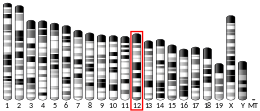 | | Chr. | Chromosome 12 (mouse)[2] |
|---|
| | Band | 12|12 F2 | Start | 116,405,402 bp[2] |
|---|
| End | 116,463,731 bp[2] |
|---|
|
| RNA expression pattern |
|---|
 | | More reference expression data |
|
| Gene ontology |
|---|
| Molecular function | • methylated histone binding
• GO:0001948 protein binding
• bHLH transcription factor binding
• molecular function regulator
|
|---|
| Cellular component | • membrane
• cell nucleus
• nucleoplasm
• condensin complex
• nuclear speck
|
|---|
| Biological process | • cell division
• cell cycle
• chromosome condensation
• inner cell mass cell proliferation
• transcription from RNA polymerase II promoter
• erythrocyte differentiation
• negative regulation of erythrocyte differentiation
• positive regulation of protein tyrosine kinase activity
• positive regulation of receptor activity
|
|---|
| Sources:Amigo / QuickGO |
|
| Orthologs |
|---|
| Species | Human | Mouse |
|---|
| Entrez | | |
|---|
| Ensembl | | |
|---|
| UniProt | | |
|---|
| RefSeq (mRNA) | |
|---|
NM_001281932
NM_001281933
NM_017760 |
| |
|---|
| RefSeq (protein) | |
|---|
NP_001268861
NP_001268862
NP_060230 |
| |
|---|
| Location (UCSC) | Chr 7: 158.63 – 158.7 Mb | Chr 12: 116.41 – 116.46 Mb |
|---|
| PubMed search | [3] | [4] |
|---|
| Wikidata |
| View/Edit Human | View/Edit Mouse |
|
Clinical importanceEditMutations in this gene in humans have been associated with severe neurodevelopmental defects, failure to thrive, ocular abnormalities, and defects in urogenital and limb morphogenesis.[8]


