Baculoviral IAP repeat-containing protein 1 is a protein that in humans is encoded by the NAIP gene.[5][6]
| NAIP |
|---|
|
| Available structures |
|---|
| PDB | Ortholog search: PDBe RCSB |
|---|
|
|
| Identifiers |
|---|
| Aliases | NAIP, BIRC1, NLRB1, psiNLR family, apoptosis inhibitory protein, NLR family apoptosis inhibitory protein |
|---|
| External IDs | OMIM: 600355 MGI: 1298226 HomoloGene: 136092 GeneCards: NAIP |
|---|
| Gene location (Human) |
|---|
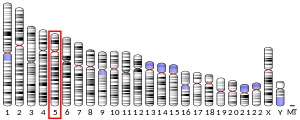 | | Chr. | Chromosome 5 (human)[1] |
|---|
| | Band | 5q13.2 | Start | 70,968,483 bp[1] |
|---|
| End | 71,025,114 bp[1] |
|---|
|
| Gene location (Mouse) |
|---|
 | | Chr. | Chromosome 13 (mouse)[2] |
|---|
| | Band | 13 D1|13 53.01 cM | Start | 100,144,063 bp[2] |
|---|
| End | 100,202,092 bp[2] |
|---|
|
| Gene ontology |
|---|
| Molecular function | • peptidase inhibitor activity
• nucleotide binding
• cysteine-type endopeptidase inhibitor activity
• metal ion binding
• ubiquitin-protein transferase activity
• GO:0001948 protein binding
• ATP binding
• cysteine-type endopeptidase inhibitor activity involved in apoptotic process
|
|---|
| Cellular component | • perikaryon
• neuronal cell body
• basolateral plasma membrane
• neuron projection
• cytoplasm
• cell nucleus
|
|---|
| Biological process | • negative regulation of neuron apoptotic process
• negative regulation of cysteine-type endopeptidase activity involved in apoptotic process
• response to amino acid
• negative regulation of peptidase activity
• immune system process
• nervous system development
• response to axon injury
• innate immune system
• inflammatory response
• apoptotic process
• protein ubiquitination
• positive regulation of canonical Wnt signaling pathway
• mitotic spindle assembly
• inhibition of cysteine-type endopeptidase activity involved in apoptotic process
• negative regulation of apoptotic process
|
|---|
| Sources:Amigo / QuickGO |
|
| Orthologs |
|---|
| Species | Human | Mouse |
|---|
| Entrez | | |
|---|
| Ensembl | |
|---|
ENSG00000278613
ENSG00000276068
ENSG00000249437 |
| |
|---|
| UniProt | | |
|---|
| RefSeq (mRNA) | |
|---|
NM_004536
NM_022892
NM_001346870 |
| |
|---|
| RefSeq (protein) | |
|---|
NP_001333799
NP_004527
NP_075043 |
| |
|---|
| Location (UCSC) | Chr 5: 70.97 – 71.03 Mb | Chr 13: 100.14 – 100.2 Mb |
|---|
| PubMed search | [3] | [4] |
|---|
| Wikidata |
| View/Edit Human | View/Edit Mouse |
|
This gene is part of a 500 kb inverted duplication on chromosome 5q13. This duplicated region contains at least four genes and repetitive elements which make it prone to rearrangements and deletions. The repetitiveness and complexity of the sequence have also caused difficulty in determining the organization of this genomic region. This copy of the gene is full length; additional copies with truncations and internal deletions are also present in this region of chromosome 5q13. It is thought that this gene is a modifier of spinal muscular atrophy caused by mutations in a neighboring gene, SMN1. The protein encoded by this gene contains regions of homology to two baculovirus inhibitor of apoptosis proteins, and it is able to suppress apoptosis induced by various signals. Alternatively spliced transcript variants encoding distinct isoforms have been found for this gene.[6]



