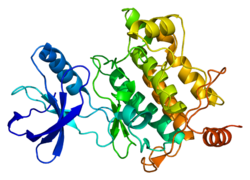
Mitogen-activated protein kinase kinase kinase 7 (MAP3K7), also known as TAK1, is an enzyme that in humans is encoded by the MAP3K7 gene.[3]
| MAP3K7 |
|---|
 |
| Available structures |
|---|
| PDB | Human UniProt search: PDBe RCSB |
|---|
| List of PDB id codes |
|---|
2EVA, 2YIY, 4GS6, 4L3P, 4L52, 4L53, 4O91, 5JGD, 5JGA |
|
|
| Identifiers |
|---|
| Aliases | MAP3K7, MEKK7, TAK1, TGF1a, mitogen-activated protein kinase kinase kinase 7, FMD2, CSCF |
|---|
| External IDs | OMIM: 602614 HomoloGene: 135715 GeneCards: MAP3K7 |
|---|
| Gene location (Human) |
|---|
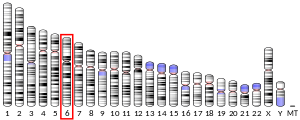 | | Chr. | Chromosome 6 (human)[1] |
|---|
| | Band | 6q15 | Start | 90,513,573 bp[1] |
|---|
| End | 90,587,072 bp[1] |
|---|
|
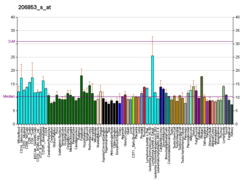
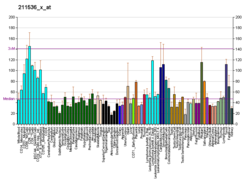
| RNA expression pattern |
|---|

 | | More reference expression data |
|
| Gene ontology |
|---|
| Molecular function | • transferase activity
• protein kinase activity
• nucleotide binding
• scaffold protein binding
• metal ion binding
• kinase activity
• protein serine/threonine kinase activity
• GO:0001948 protein binding
• ATP binding
• magnesium ion binding
• MAP kinase kinase kinase activity
• identical protein binding
• receptor tyrosine kinase binding
|
|---|
| Cellular component | • cytosol
• Ada2/Gcn5/Ada3 transcription activator complex
• membrane
• cell membrane
• endosome membrane
• cell nucleus
• IkappaB kinase complex
• cytoplasm
|
|---|
| Biological process | • regulation of transcription, DNA-templated
• phosphorylation
• activation of MAPKK activity
• positive regulation of JUN kinase activity
• stimulatory C-type lectin receptor signaling pathway
• activation of NF-kappaB-inducing kinase activity
• I-kappaB phosphorylation
• MyD88-dependent toll-like receptor signaling pathway
• transcription, DNA-templated
• Fc-epsilon receptor signaling pathway
• protein phosphorylation
• JNK cascade
• activation of MAPK activity
• positive regulation of T cell activation
• positive regulation of NF-kappaB transcription factor activity
• positive regulation of interleukin-2 production
• positive regulation of T cell cytokine production
• histone H3 acetylation
• positive regulation of I-kappaB kinase/NF-kappaB signaling
• I-kappaB kinase/NF-kappaB signaling
• transforming growth factor beta receptor signaling pathway
• T cell receptor signaling pathway
• nucleotide-binding oligomerization domain containing signaling pathway
• signal transduction
• apoptotic process
• Wnt signaling pathway, calcium modulating pathway
• stress-activated MAPK cascade
• positive regulation of macroautophagy
• protein deubiquitination
• anoikis
• MyD88-independent toll-like receptor signaling pathway
• GO:0022415 viral process
• interleukin-1-mediated signaling pathway
|
|---|
| Sources:Amigo / QuickGO |
|
| Orthologs |
|---|
| Species | Human | Mouse |
|---|
| Entrez | | |
|---|
| Ensembl | | |
|---|
| UniProt | | |
|---|
| RefSeq (mRNA) | |
|---|
NM_003188
NM_145331
NM_145332
NM_145333 |
| |
|---|
| RefSeq (protein) | |
|---|
NP_003179
NP_663304
NP_663305
NP_663306 |
| |
|---|
| Location (UCSC) | Chr 6: 90.51 – 90.59 Mb | n/a |
|---|
| PubMed search | [2] | n/a |
|---|
| Wikidata |
|
FunctionEditThe protein encoded by this gene is a member of the serine/threonine protein kinase family. This kinase mediates signal transduction induced by TGF beta and morphogenetic protein (BMP), and controls a variety of cell functions including transcription regulation and apoptosis. TAK1 is a central regulator of cell death and is activated through a diverse set of intra- and extracellular stimuli. TAK1 regulates cell survival not solely through NF-κB but also through NF-κB-independent pathways such as oxidative stress and receptor-interacting protein kinase 1 (RIPK1) kinase activity-dependent pathway.[4] In response to IL-1, this protein forms a kinase complex including TRAF6, MAP3K7P1/TAB1 and MAP3K7P2/TAB2; this complex is required for the activation of nuclear factor kappa B. This kinase can also activate MAPK8/JNK, MAP2K4/MKK4, and thus plays a role in the cell response to environmental stresses. Four alternatively spliced transcript variants encoding distinct isoforms have been reported.[5]
This kinase has also been shown to regulate downstream cytokine expression such as TNF. Due to its regulation of TNF, TAK1 has become a novel target for the treatment of TNF mediated diseases such as auto immune disease ( Rheumatoid Arthritis, lupus, IBD) but also other cytokine mediated disorders such as chronic pain and cancer.[6] With the advent of novel selective TAK1 inhibitors, groups have explored the therapeutic potential of TAK1 targeted therapies. One group has shown that the selective TAK1 inhibitor, Takinib developed at Duke University attenuated rheumatoid arthritis like pathology in the CIA mouse model of human inflammatory arthritis.[7] Furthermore, pharmacological inhibition of TAK1 has shown to reduce inflammatory cytokines in particular TNF.[8]


