Lymphocyte antigen 96, also known as "Myeloid Differentiation factor 2 (MD-2)," is a protein that in humans is encoded by the LY96 gene.[5][6][7][8]
| LY96 |
|---|
 |
| Available structures |
|---|
| PDB | Ortholog search: PDBe RCSB |
|---|
| List of PDB id codes |
|---|
2E56, 2E59, 2Z65, 3FXI, 3ULA, 4G8A |
|
|
| Identifiers |
|---|
| Aliases | LY96, ESOP-1, MD-2, MD2, ly-96, lymphocyte antigen 96 |
|---|
| External IDs | OMIM: 605243 MGI: 1341909 HomoloGene: 9109 GeneCards: LY96 |
|---|
| Gene location (Human) |
|---|
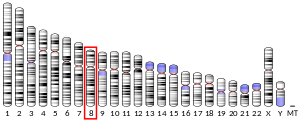 | | Chr. | Chromosome 8 (human)[1] |
|---|
| | Band | 8q21.11 | Start | 73,991,392 bp[1] |
|---|
| End | 74,029,079 bp[1] |
|---|
|
| Gene location (Mouse) |
|---|
 | | Chr. | Chromosome 1 (mouse)[2] |
|---|
| | Band | 1|1 A3 | Start | 16,688,051 bp[2] |
|---|
| End | 16,709,611 bp[2] |
|---|
|
| RNA expression pattern |
|---|
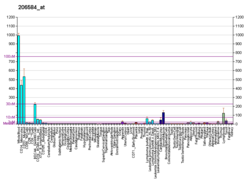 | | More reference expression data |
|
| Gene ontology |
|---|
| Molecular function | • coreceptor activity
• GO:0001948 protein binding
• lipopolysaccharide receptor activity
• lipopolysaccharide binding
• Toll-like receptor 4 binding
|
|---|
| Cellular component | • intrinsic component of plasma membrane
• cell membrane
• extracellular region
• lipopolysaccharide receptor complex
• endosome membrane
• extracellular
|
|---|
| Biological process | • toll-like receptor 4 signaling pathway
• immune system process
• MyD88-dependent toll-like receptor signaling pathway
• positive regulation of lipopolysaccharide-mediated signaling pathway
• TRIF-dependent toll-like receptor signaling pathway
• cellular defense response
• cell surface receptor signaling pathway
• response to lipopolysaccharide
• positive regulation of tumor necrosis factor production
• inflammatory response
• cellular response to lipopolysaccharide
• detection of lipopolysaccharide
• I-kappaB kinase/NF-kappaB signaling
• MyD88-independent toll-like receptor signaling pathway
• lipopolysaccharide-mediated signaling pathway
• negative regulation of MyD88-independent toll-like receptor signaling pathway
• innate immune system
• GO:0060554, GO:0060555 necroptosis
• apoptotic signaling pathway
• toll-like receptor signaling pathway
|
|---|
| Sources:Amigo / QuickGO |
|
| Orthologs |
|---|
| Species | Human | Mouse |
|---|
| Entrez | | |
|---|
| Ensembl | | |
|---|
| UniProt | | |
|---|
| RefSeq (mRNA) | | |
|---|
| RefSeq (protein) | | |
|---|
| Location (UCSC) | Chr 8: 73.99 – 74.03 Mb | Chr 1: 16.69 – 16.71 Mb |
|---|
| PubMed search | [3] | [4] |
|---|
| Wikidata |
| View/Edit Human | View/Edit Mouse |
|
The protein encoded by this gene is involved in binding lipopolysaccharide with Toll-Like Receptor (TLR4).
FunctionEditThe MD-2 protein appears to associate with toll-like receptor 4 on the cell surface and confers responsiveness to lipopolysaccharide (LPS), thus providing a link between the receptor and LPS signaling.[7] That is, the primary interface between TLR4 and MD-2 is formed before binding LPS and the dimerization interface is induced by binding LPS.[8]
StructureEditMD-2 has a β-cup fold structure composed of two anti-parallel β sheets forming a large hydrophobic pocket for ligand binding.[9][10]
InteractionsEditLymphocyte antigen 96 has been shown to interact with TLR 4.[5][11]
When LPS binds to a hydrophobic pocket in MD-2, it directly mediates dimerization of the two TLR4-MD-2 complexes. Thus, MD-2 form a heterodimer that recognizes a common pattern in structurally diverse LPS molecules. These interactions allow TLR4 to recognize LPS.[8]
LPS is extracted from the bacterial membrane and transferred to TLR4-MD-2 by two accessory proteins, LPS-binding protein and CD14, to induce innate immune response.[8]


