The p75 neurotrophin receptor (p75NTR) was first identified as the low-affinity nerve growth factor (LNGFR)[5][6] before discovery that p75NTR bound other neurotrophins equally well as Nerve growth factor.[7][8] p75NTR is a neurotrophic factor receptor. Neurotrophic factor receptors bind Neurotrophins including Nerve growth factor, Neurotrophin-3, Brain-derived neurotrophic factor, and Neurotrophin-4. All neurotrophins bind to p75NTR. Neurotrophic factor receptors, including p75NTR, are responsible for ensuring a proper density to target ratio of developing neurons, refining broader maps in development into precise connections. p75NTR is involved in pathways that promote neuronal survival and neuronal death.[7]






Receptor Family
p75NTR is a member of the tumor necrosis factor receptor superfamily. p75NTR/LNGFR was the first member of this large family of receptors to be characterized.[5][6][9]
Structure
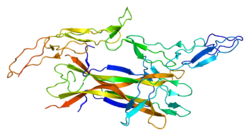
Four cysteine-rich domains, CRD1, CRD2, CRD3, and CRD4, make up the p75NTR extracellular domain. The extracellular domain is an elongated and kinked structure. p75NTR binds to Nerve growth factor dimers through two spatially separated binding sites, one between CRD1 and CRD2, and one between CRD3 and CRD4.[9]
Function
Interactions with Neurotrophins
Neurotrophins that interact with p75NTR include NGF, NT-3, BDNF, and NT-4/5.[7] Neurotrophins activating p75NTR may initiate apoptosis (for example, via c-Jun N-terminal kinases signaling), and this effect can be counteracted by anti-apoptotic signaling by TrkA.[10] Neurotrophin binding to p75NTR, in addition to apoptotic signaling, can also promote neuronal survival (for example, via NF-kB activation).[11]
Interactions with proneurotrophins
Proforms of NGF and BNDF (proNGF and proBNDF) are precursors to NGF and BNDF. proNGF and proBNDF interact with p75NTR and cause p75NTR-mediated apoptosis without activating TrkA-mediated survival mechanisms. Cleavage of proforms into mature Neurotrophins allows the mature NGF and BDNF to activate TrkA-mediated survival mechanisms.[12][13]
Sensory Development
Recent research has suggested a number of roles for the LNGFR, including in development of the eyes and sensory neurons,[14][15] and in repair of muscle and nerve damage in adults.[16][17][18]Two distinct subpopulations of Olfactory ensheathing glia have been identified[19] with high or low cell surface expression of low-affinity nerve growth factor receptor (p75).
Interactions with other receptors
Sortilin
Sortilin is required for many apoptosis-promoting p75NTR reactions, functioning as a co-receptor for the binding of neurotrophins such as BDNF. pro-neurotrophins (such as proBDNF) bind especially well to p75NTR when sortilin is present.[20]
Crosstalk with Trk Receptors
When p75NTR initiates apoptosis, NGF binding to Tropomyosin receptor kinase A (TrkA) can negate p75NTR apoptotic effects. p75NTR c-Jun kinase pathway activation (which causes apoptosis) is suppressed when NGF binds to TrkA. p75NTR activation of NF-kB, which promotes survival, is unaffected by NGF binding to TrkA.[20]
Nogo-66 Receptor (NgR1)
p75NTR functions in a complex with Nogo-66 receptor (NgR1] to mediate RhoA-dependent inhibition of growth of regenerating axons exposed to inhibitory proteins of CNS myelin, such as Nogo, MAG or OMgP. Without p75NTR, OMgP can activate RhoA and inhibit CNS axon regeneration. Coexpression of p75NTR and OMgP suppress RhoA activation. A complex of NgR1, p75NTR and LINGO1 can activate RhoA.[21]
p75NTR-mediated Signaling Pathways
NF-kB Activation
NF-kB is a transcription factor that can be activated by p75NTR. Nerve growth factor (NGF) is a neurotrophin that promotes neuronal growth, and, in the absence of NGF, neurons die. Neuronal death in the absence of NGF can be prevented by NF-kB activation. Phosphorylated IκB kinase binds to and activates NF-kB before separating from NF-kB. After separation, IκB degrades and NF-kB continues to the nucleus to initiate pro-survival transcription. NF-kB also promotes neuronal survival in conjunction with NGF.[11]
NF-kB activity is activated by p75NTR, and is not activated via Trk receptors. NF-kB activity does not effect Brain-derived neurotrophic factor promotion of neuronal survival.[11]
RhoGDI and RhoA
p75NTR serves as a regulator for actin assembly. Ras homolog family member A (RhoA) causes the actin cytoskeleton to become rigid which limits growth cone mobility and inhibits neuronal elongation in the developing nervous system. p75NTR without a ligand bound activates RhoA and limits actin assembly, but neurotrophin binding to p75NTR can inactivate RhoA and promote actin assembly.[22] p75NTR associates with the Rho GDP dissociation inhibitor (RhoGDI), and RhoGDI associates with RhoA. Interactions with Nogo can strengthen the association between p75NTR and RhoGDI. Neurotrophin binding to p75NTR inhibits the association of RhoGDI and p75NTR, thereby suppressing RhoA release and promoting growth cone elongation (inhibiting RhoA actin suppression).[23]
JNK Signaling Pathway
Neurotrophin binding to p75NTR activates the c-Jun N-terminal kinases (JNK) signaling pathway causing apoptosis of developing neurons. JNK, through a series of intermediates, activates p53 and p53 activates Bax which initiates apoptosis. TrkA can prevent p75NTR-mediated JNK pathway apoptosis.[24]
JNK-Bim-EL Signaling Pathway
JNK can directly phosphorylate Bim-EL, a splicing isoform of Bcl-2 interacting mediator of cell death (Bim), which activates Bim-EL apoptotic activity. JNK activation is required for apoptosis but c-jun, a protein in the JNK signaling pathway, is not always required.[10]
Caspase-dependent signaling
LNGFR also activates a caspase-dependent signaling pathway that promotes developmental axon pruning, and axon degeneration in neurodegenerative disease[citation needed].
Role in Disease
Huntington's Disease
Huntington's disease is characterized by cognitive impairments. There is increased expression of p75NTR in the hippocampus of Huntington's disease patients (including mice models and humans). Over expression of p75NTR in mice causes cognitive impairments similar to Huntington's disease. p75NTR is linked to reduced numbers of dendritic spines in the hippocampus, likely through p75NTR interactions with Transforming protein RhoA. Modulating p75NTR function could be a future direction in treating Huntington's disease.[25]
Role in cancer stem cells
p75NTR has been implicated as a marker for cancer stem cells in melanoma and other cancers. Melanoma cells transplanted into an immunodeficient mouse model were shown to require expression of CD271 in order to grow a melanoma.[26] Gene knockdown of CD271 has also been shown to abolish neural crest stem cell properties of melanoma cells and decrease genomic stability leading to a reduced migration, tumorigenicity, proliferation and induction of apoptosis.[27][28][29] Furthermore, increased levels of CD271 were observed in brain metastatic melanoma cells whereas resistance to the BRAF inhibitor vemurafenib supposedly selects for highly malignant brain and lung-metastasizing melanoma cells.[30][31][32][33]
| This article uses material from the Wikipedia article Metasyntactic variable, which is released under the Creative Commons Attribution-ShareAlike 3.0 Unported License. |