Gamma-aminobutyric acid receptor subunit beta-2 is a protein that in humans is encoded by the GABRB2 gene.[5][6]
| GABRB2 |
|---|
|
| Identifiers |
|---|
| Aliases | GABRB2, gamma-aminobutyric acid type A receptor beta2 subunit, ICEE2, gamma-aminobutyric acid type A receptor subunit beta2 |
|---|
| External IDs | OMIM: 600232 MGI: 95620 HomoloGene: 7327 GeneCards: GABRB2 |
|---|
| Gene location (Human) |
|---|
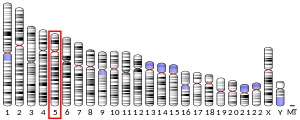 | | Chr. | Chromosome 5 (human)[1] |
|---|
| | Band | 5q34 | Start | 161,288,429 bp[1] |
|---|
| End | 161,549,044 bp[1] |
|---|
|
| Gene location (Mouse) |
|---|
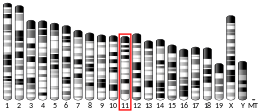 | | Chr. | Chromosome 11 (mouse)[2] |
|---|
| | Band | 11 A5|11 25.08 cM | Start | 42,419,757 bp[2] |
|---|
| End | 42,629,028 bp[2] |
|---|
|
| RNA expression pattern |
|---|
 | | More reference expression data |
|
| Gene ontology |
|---|
| Molecular function | • inhibitory extracellular ligand-gated ion channel activity
• ion channel activity
• GABA receptor activity
• chloride channel activity
• extracellular ligand-gated ion channel activity
• GABA-A receptor activity
• transmembrane signaling receptor activity
• transmitter-gated ion channel activity involved in regulation of postsynaptic membrane potential
• GABA-gated chloride ion channel activity
|
|---|
| Cellular component | • integral component of membrane
• cytosol
• GABA-A receptor complex
• postsynaptic membrane
• membrane
• cell membrane
• integral component of plasma membrane
• synapse
• chloride channel complex
• cell junction
• GABA receptor complex
• extracellular exosome
• cytoplasmic vesicle membrane
• cytoplasmic vesicle
• neuron projection
• GABA-ergic synapse
• integral component of postsynaptic specialization membrane
|
|---|
| Biological process | • gamma-aminobutyric acid signaling pathway
• negative regulation of neuron apoptotic process
• chemical synaptic transmission
• cochlea development
• regulation of neuron apoptotic process
• neuron development
• chloride transmembrane transport
• synaptic transmission, GABAergic
• sensory perception of sound
• ion transport
• inner ear receptor cell development
• chloride transport
• innervation
• negative regulation of neuron death
• cellular response to histamine
• transport
• signal transduction
• ion transmembrane transport
• regulation of membrane potential
• nervous system process
• postsynaptic potential
• inhibitory synapse assembly
|
|---|
| Sources:Amigo / QuickGO |
|
| Orthologs |
|---|
| Species | Human | Mouse |
|---|
| Entrez | | |
|---|
| Ensembl | | |
|---|
| UniProt | | |
|---|
| RefSeq (mRNA) | |
|---|
NM_000813
NM_021911
NM_001371727 |
| |
|---|
NM_008070
NM_001347314
NM_001362646
NM_001362647
NM_001362649 |
|
|---|
| RefSeq (protein) | |
|---|
NP_000804
NP_068711
NP_001358656 |
| |
|---|
NP_001334243
NP_032096
NP_001349575
NP_001349576
NP_001349578 |
|
|---|
| Location (UCSC) | Chr 5: 161.29 – 161.55 Mb | Chr 11: 42.42 – 42.63 Mb |
|---|
| PubMed search | [3] | [4] |
|---|
| Wikidata |
| View/Edit Human | View/Edit Mouse |
|
FunctionEditThe gamma-aminobutyric acid (GABA) A receptor is a multisubunit chloride channel that mediates the fastest inhibitory synaptic transmission in the central nervous system. This gene encodes GABA A receptor, beta 2 subunit. It is mapped to chromosome 5q34 in a cluster of genes encoding alpha 1 and gamma 2 subunits of the GABA A receptor. Alternative splicing of this gene generates 2 transcript variants, differing by a 114 bp insertion.[6]
Clinical significanceEditMissense mutations of GABRB2 have been identified in patients with infantile onset epilepsy and intellectual disability.[7][8]
InteractionsEditGABRB2 has been shown to interact with TRAK2.[9]



