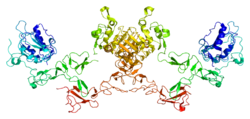
Receptor tyrosine-protein kinase erbB-4 is an enzyme that in humans is encoded by the ERBB4 gene.[5][6] Alternatively spliced variants that encode different protein isoforms have been described; however, not all variants have been fully characterized.[7]
| ERBB4 |
|---|
 |
| Available structures |
|---|
| PDB | Ortholog search: PDBe RCSB |
|---|
| List of PDB id codes |
|---|
2AHX, 2L2T, 2LCX, 2R4B, 3BBT, 3BBW, 3BCE, 3U2P, 3U7U, 3U9U |
|
|
| Identifiers |
|---|
| Aliases | ERBB4, ALS19, HER4, p180erbB4, erb-b2 receptor tyrosine kinase 4 |
|---|
| External IDs | OMIM: 600543 MGI: 104771 HomoloGene: 21084 GeneCards: ERBB4 |
|---|
| Gene location (Human) |
|---|
 | | Chr. | Chromosome 2 (human)[1] |
|---|
| | Band | 2q34 | Start | 211,375,717 bp[1] |
|---|
| End | 212,538,841 bp[1] |
|---|
|
| Gene location (Mouse) |
|---|
 | | Chr. | Chromosome 1 (mouse)[2] |
|---|
| | Band | 1 C3|1 33.8 cM | Start | 68,032,186 bp[2] |
|---|
| End | 69,108,059 bp[2] |
|---|
|
| RNA expression pattern |
|---|
 | | More reference expression data |
|
| Gene ontology |
|---|
| Molecular function | • transferase activity
• nucleotide binding
• protein kinase activity
• protein homodimerization activity
• epidermal growth factor receptor binding
• kinase activity
• GO:0001948 protein binding
• transmembrane receptor protein tyrosine kinase activity
• ATP binding
• protein tyrosine kinase activity
• Ras guanyl-nucleotide exchange factor activity
• phosphatidylinositol-4,5-bisphosphate 3-kinase activity
• receptor tyrosine kinase
• transmembrane signaling receptor activity
|
|---|
| Cellular component | • integral component of membrane
• cytosol
• membrane
• receptor complex
• cell membrane
• nucleoplasm
• extracellular region
• mitochondrial matrix
• basolateral plasma membrane
• mitochondrion
• cell nucleus
• postsynaptic membrane
• glutamatergic synapse
• GABA-ergic synapse
• integral component of presynaptic membrane
• integral component of postsynaptic density membrane
• cytoplasm
• integral component of plasma membrane
• basal plasma membrane
|
|---|
| Biological process | • mitochondrial fragmentation involved in apoptotic process
• negative regulation of neuron migration
• cell fate commitment
• positive regulation of protein phosphorylation
• regulation of cell migration
• regulation of transcription, DNA-templated
• olfactory bulb interneuron differentiation
• embryonic pattern specification
• phosphorylation
• transmembrane receptor protein tyrosine kinase signaling pathway
• central nervous system morphogenesis
• mammary gland alveolus development
• transcription, DNA-templated
• nervous system development
• mammary gland epithelial cell differentiation
• MAPK cascade
• positive regulation of phosphatidylinositol 3-kinase activity
• positive regulation of transcription, DNA-templated
• multicellular organism development
• heart development
• protein phosphorylation
• positive regulation of cardiac muscle cell proliferation
• neural crest cell migration
• positive regulation of ERK1 and ERK2 cascade
• positive regulation of protein localization to cell surface
• autophosphorylation
• cardiac muscle tissue regeneration
• positive regulation of phosphatidylinositol 3-kinase signaling
• peptidyl-tyrosine phosphorylation
• lactation
• cellular proliferation
• cell migration
• signal transduction
• negative regulation of cell proliferation
• apoptotic process
• ERBB2 signaling pathway
• phosphatidylinositol phosphorylation
• peptidyl-tyrosine autophosphorylation
• positive regulation of cell proliferation
• positive regulation of apoptotic process
• regulation of cell motility
• negative regulation of apoptotic process
• cellular response to epidermal growth factor stimulus
• positive regulation of tyrosine phosphorylation of STAT protein
• positive regulation of protein kinase B signaling
• positive regulation of JAK-STAT cascade
• synapse assembly
• negative regulation of signal transduction
• cell differentiation
|
|---|
| Sources:Amigo / QuickGO |
|
| Orthologs |
|---|
| Species | Human | Mouse |
|---|
| Entrez | | |
|---|
| Ensembl | | |
|---|
| UniProt | | |
|---|
| RefSeq (mRNA) | | |
|---|
| RefSeq (protein) | | |
|---|
| Location (UCSC) | Chr 2: 211.38 – 212.54 Mb | Chr 1: 68.03 – 69.11 Mb |
|---|
| PubMed search | [3] | [4] |
|---|
| Wikidata |
| View/Edit Human | View/Edit Mouse |
|
FunctionEditReceptor tyrosine-protein kinase erbB-4 is a receptor tyrosine kinase that is a member of the epidermal growth factor receptor family. ERBB4 is a single-pass type I transmembrane protein with multiple furin-like cysteine rich domains, a tyrosine kinase domain, a phosphotidylinositol-3 kinase binding site and a PDZ domain binding motif. The protein binds to and is activated by neuregulins-2 and -3, heparin-binding EGF-like growth factor and betacellulin. Ligand binding induces a variety of cellular responses including mitogenesis and differentiation. Multiple proteolytic events allow for the release of a cytoplasmic fragment and an extracellular fragment.[7]
Clinical significanceEditMutations in this gene have been associated with cancer.[7] Other single-nucleotide polymorphisms and a risk haplotype have been linked to schizophrenia.[8] Single-nucleotide polymorphisms in ERBB4 have also been found in a study of patients with familial amyotrophic lateral sclerosis type 19.[9]


