Dopamine receptor D3 is a protein that in humans is encoded by the DRD3 gene.[5][6]

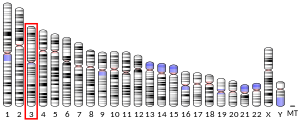


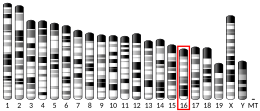



This gene encodes the D3 subtype of the dopamine receptor. The D3 subtype inhibits adenylyl cyclase through inhibitory G-proteins. This receptor is expressed in phylogenetically older regions of the brain, suggesting that this receptor plays a role in cognitive and emotional functions.[citation needed] It is a target for drugs which treat schizophrenia, drug addiction, and Parkinson's disease.[7] Alternative splicing of this gene results in multiple transcript variants that would encode different isoforms, although some variants may be subject to nonsense-mediated decay (NMD).[6]
Function
D3 agonists like 7-OH-DPAT, pramipexole, and rotigotine, among others, display antidepressant effects in rodent models of depression.[8][9]
Animal studies
D3 agonists have been shown to disrupt prepulse inhibition of startle (PPI), a cross-species measure that recapitulates deficits in sensorimotor gating in neuropsychiatric disorders such as schizophrenia.[10][11][12] In contrast, D3-preferring antagonists have antipsychotic-like profiles in measures of PPI in rats.[13]
Ligands
Agonists
- trans-N-{4-[4-(2,3-Dichlorophenyl)-1-piperazinyl]cyclohexyl}-3-methoxybenzamide, full agonist, > 200-fold binding selectivity over D4, D2, 5-HT1A, and α1-receptors[14]
- (-)-7-{[2-(4-Phenylpiperazin-1-yl)ethyl]propylamino}-5,6,7,8-tetrahydronaphthalen-2-ol[15]
- 5-OH-DPAT
- 7-OH-DPAT
- Pergolide[16]
- 8-OH-PBZI (cis-8-Hydroxy-3-(n-propyl)-1,2,3a,4,5,9b-hexahydro-1H-benz[e]indole)
- Apomorphine (non-selective dopamine agonist)
- Bromocriptine (non-selective dopamine agonist)
- Captodiame
- CJ-1639[17]
- compound R,R-16: 250x binding selectivity over D2[18]
- Dopamine (endogenous agonist)
- ES609
- FAUC 54
- FAUC 73
- PD-128,907
- PF-219,061 (extremely selective) [19]
- PF-592,379[20]
- Piribedil[21] (non-selective dopamine agonist)
- Pramipexole (non-selective dopamine agonist)
- Quinelorane (also D2 agonist)
- Quinpirole (also D2 agonist)
- Ropinirole (non-selective dopamine agonist)
- Rotigotine (non-selective dopamine agonist)
Partial agonists
- Aripiprazole (non-selective)
- BP-897[22]
- Brexpiprazole (non-selective)
- Buspirone (non-selective)
- Cariprazine
- CJB 090
- CJ-1037 (extremely selective) [23]
- FAUC 460 (highly selective) [24]
- FAUC 346 (highly selective)[25]
- Pardoprunox (non-selective)
- Roxindole (possibly a partial agonist at the D3 autoreceptors, non-selective)
- OS-3-106
- UH-232
- WW-III-55
Antagonists
- Most Antipsychotics
- Amisulpride (non-selective)
- Cyproheptadine (non-selective)
- PG 01037 [26][27]
- Domperidone (peripheral D2 and D3 antagonist)
- FAUC 365, silent antagonist, subtype selective[25]
- GR-103,691
- GSK598809 (highly selective)
- Haloperidol (non-selective, blocks all dopamine receptor subtypes, though D3 with the strongest affinity)
- N-(4-(4-(2,3-Dichloro- or 2-methoxyphenyl)piperazin-1-yl)butyl)heterobiarylcarboxamides[28]
- Nafadotride
- NGB-2904[29]
- PNU-99,194 (moderately selective over D2)
- Raclopride (also D2 antagonist)
- S-14,297 (selective)
- S33084
- SB-277011-A, selective D3 antagonist, 80x selectivity over D2 with no partial agonist effects, used in drug addiction research as a potential therapy for addiction to several different drugs
- SR 21502 (highly selective)
- Sulpiride (also D2 antagonist)
- U99194
- YQA14 (high affinity and selectivity)
- Risperidone
Interactions
Dopamine receptor D3 has been shown to interact with CLIC6[30] and EPB41L1.[31]
| This article uses material from the Wikipedia article Metasyntactic variable, which is released under the Creative Commons Attribution-ShareAlike 3.0 Unported License. |