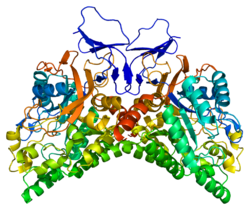
Collapsin response mediator protein 1, encoded by the CRMP1 gene, is a human protein of the CRMP family.[5]
| CRMP1 |
|---|
 |
| Available structures |
|---|
| PDB | Ortholog search: PDBe RCSB |
|---|
|
|
| Identifiers |
|---|
| Aliases | CRMP1, CRMP-1, DPYSL1, DRP-1, DRP1, ULIP-3, collapsin response mediator protein 1 |
|---|
| External IDs | OMIM: 602462 MGI: 107793 HomoloGene: 20347 GeneCards: CRMP1 |
|---|
| Gene location (Human) |
|---|
 | | Chr. | Chromosome 4 (human)[1] |
|---|
| | Band | 4p16.2 | Start | 5,748,084 bp[1] |
|---|
| End | 5,893,086 bp[1] |
|---|
|
| Gene location (Mouse) |
|---|
 | | Chr. | Chromosome 5 (mouse)[2] |
|---|
| | Band | 5 B3|5 19.96 cM | Start | 37,241,940 bp[2] |
|---|
| End | 37,292,133 bp[2] |
|---|
|
| RNA expression pattern |
|---|
 | | More reference expression data |
|
| Gene ontology |
|---|
| Molecular function | • GO:0001948 protein binding
• hydrolase activity
• hydrolase activity, acting on carbon-nitrogen (but not peptide) bonds
• filamin binding
|
|---|
| Cellular component | • spindle
• cytoskeleton
• microtubule organizing center
• cytoplasm
• cytosol
• midbody
• centrosome
• cell nucleus
|
|---|
| Biological process | • neuron development
• nucleobase-containing compound metabolic process
• microtubule cytoskeleton organization
• nervous system development
• axon guidance
• negative regulation of actin filament binding
• negative regulation of neuron projection development
|
|---|
| Sources:Amigo / QuickGO |
|
| Orthologs |
|---|
| Species | Human | Mouse |
|---|
| Entrez | | |
|---|
| Ensembl | | |
|---|
| UniProt | | |
|---|
| RefSeq (mRNA) | |
|---|
NM_001313
NM_001014809
NM_001288661
NM_001288662 |
| |
|---|
| RefSeq (protein) | |
|---|
NP_001014809
NP_001275590
NP_001275591
NP_001304 |
| |
|---|
| Location (UCSC) | Chr 4: 5.75 – 5.89 Mb | Chr 5: 37.24 – 37.29 Mb |
|---|
| PubMed search | [3] | [4] |
|---|
| Wikidata |
| View/Edit Human | View/Edit Mouse |
|
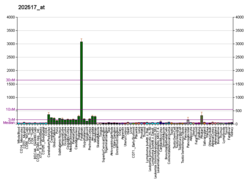
This gene encodes a member of a family of cytosolic phosphoproteins expressed exclusively in the nervous system. The encoded protein is thought to be a part of the semaphorin signal transduction pathway implicated in semaphorin-induced growth cone collapse during neural development. Alternative splicing results in multiple transcript variants.[5]
CRMP1 mediates reelin signaling in cortical neuronal migration.[6] Mice deficient in CRMP1 exhibit impaired long-term potentiation and impaired spatial learning and memory.[7]
CRMP1 gene overlaps with another gene called EVC.[8]
InteractionsEditCRMP1 has been shown to interact with DPYSL2.[9]


