B-cell lymphoma 6 protein is a protein that in humans is encoded by the BCL6 gene.[5] Like BCL2, BCL3, BCL5, BCL7A, BCL9 and BCL10, it has clinical significance in lymphoma.
| BCL6 |
|---|
 |
| Available structures |
|---|
| PDB | Ortholog search: PDBe RCSB |
|---|
| List of PDB id codes |
|---|
1R28, 1R29, 1R2B, 2EN2, 2EOS, 2LCE, 2YRM, 3BIM, 3E4U, 3LBZ, 4CP3, 4U2M |
|
|
| Identifiers |
|---|
| Aliases | BCL6, BCL5, BCL6A, LAZ3, ZBTB27, ZNF51, B-cell CLL/lymphoma 6, B cell CLL/lymphoma 6, transcription repressor, BCL6 transcription repressor |
|---|
| External IDs | OMIM: 109565 MGI: 107187 HomoloGene: 7640 GeneCards: BCL6 |
|---|
| Gene location (Human) |
|---|
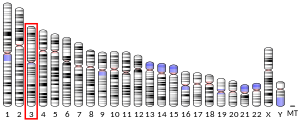 | | Chr. | Chromosome 3 (human)[1] |
|---|
| | Band | 3q27.3 | Start | 187,721,377 bp[1] |
|---|
| End | 187,745,725 bp[1] |
|---|
|
| Gene location (Mouse) |
|---|
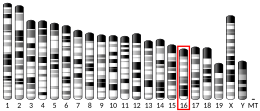 | | Chr. | Chromosome 16 (mouse)[2] |
|---|
| | Band | 16 B1|16 15.26 cM | Start | 23,965,052 bp[2] |
|---|
| End | 23,988,852 bp[2] |
|---|
|
| RNA expression pattern |
|---|

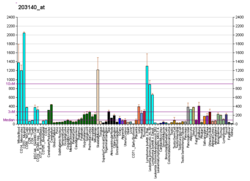 | | More reference expression data |
|
| Gene ontology |
|---|
| Molecular function | • sequence-specific DNA binding
• DNA binding
• RNA polymerase II regulatory region sequence-specific DNA binding
• GO:0001131, GO:0001151, GO:0001130, GO:0001204 DNA-binding transcription factor activity
• intronic transcription regulatory region sequence-specific DNA binding
• chromatin binding
• metal ion binding
• GO:0001948 protein binding
• GO:0001078, GO:0001214, GO:0001206 DNA-binding transcription repressor activity, RNA polymerase II-specific
• nucleic acid binding
• chromatin DNA binding
• identical protein binding
• GO:0001200, GO:0001133, GO:0001201 DNA-binding transcription factor activity, RNA polymerase II-specific
|
|---|
| Cellular component | • replication fork
• cell nucleus
• nucleoplasm
• Golgi apparatus
|
|---|
| Biological process | • regulation of germinal center formation
• positive regulation of histone deacetylation
• negative regulation of T-helper 2 cell differentiation
• protein localization
• negative regulation of mast cell cytokine production
• regulation of transcription, DNA-templated
• immune system process
• GO:0043087, GO:0032313, GO:0032319, GO:0032314, GO:0043088 regulation of GTPase activity
• regulation of transcription from RNA polymerase II promoter
• negative regulation of cell differentiation
• germinal center formation
• negative regulation of Rho protein signal transduction
• negative regulation of isotype switching to IgE isotypes
• negative regulation of apoptotic process
• negative regulation of transcription from RNA polymerase II promoter
• transcription, DNA-templated
• type 2 immune response
• cellular response to DNA damage stimulus
• negative regulation of cell-matrix adhesion
• regulation of cell proliferation
• positive regulation of B cell proliferation
• negative regulation of cell growth
• Rho protein signal transduction
• cell morphogenesis
• spermatogenesis
• regulation of memory T cell differentiation
• positive regulation of neuron differentiation
• regulation of inflammatory response
• regulation of immune response
• positive regulation of apoptotic process
• negative regulation of type 2 immune response
• negative regulation of B cell apoptotic process
• positive regulation of cellular component movement
• B cell differentiation
• inflammatory response
• negative regulation of transcription, DNA-templated
• actin cytoskeleton organization
• negative regulation of cell proliferation
• negative regulation of Notch signaling pathway
• erythrocyte development
• negative regulation of cellular senescence
• regulation of apoptotic process
• negative regulation of mitotic cell cycle DNA replication
• positive regulation of regulatory T cell differentiation
• cytokine-mediated signaling pathway
|
|---|
| Sources:Amigo / QuickGO |
|
| Orthologs |
|---|
| Species | Human | Mouse |
|---|
| Entrez | | |
|---|
| Ensembl | | |
|---|
| UniProt | | |
|---|
| RefSeq (mRNA) | |
|---|
NM_001130845
NM_001134738
NM_001706
NM_138931 |
| |
|---|
| RefSeq (protein) | |
|---|
NP_001124317
NP_001128210
NP_001697 |
| |
|---|
| Location (UCSC) | Chr 3: 187.72 – 187.75 Mb | Chr 16: 23.97 – 23.99 Mb |
|---|
| PubMed search | [3] | [4] |
|---|
| Wikidata |
| View/Edit Human | View/Edit Mouse |
|
FunctionEditThe protein encoded by this gene is an evolutionarily conserved zinc finger transcription factor and contains an N-terminal POZ/BTB domain. This protein acts as a sequence-specific repressor of transcription and has been shown to modulate the STAT-dependent Interleukin 4 (IL-4) responses of B cells. This protein can interact with several corepressor complexes to inhibit transcription. This gene is found to be frequently translocated and hypermutated in diffuse large B cell lymphoma (DLBCL)[6][7][8] and contributes to the pathogenesis of DLBCL. An exon 7 skipping splice variant encodes a shorter form of the protein which lacks the first two zinc fingers of the DNA binding domain.[9]
Physiologically, BCL6 is a master transcription factor which leads the differentiation of naive helper T cells in Follicular Helper T cells (TFH cells).[10] Its action is negatively regulated by the gene PRDM1 encoding the transcription factor Blimp-1.[11]
Diagnostic utilityEditThe presence of BCL6 can be demonstrated in tissue sections using immunohistochemistry. It is exclusively present in the B-cells of both healthy and neoplastic germinal centres. It therefore demonstrates both reactive hyperplasia in lymph nodes and a range of lymphomas derived from follicular B-cells, such as Burkitt's lymphoma, follicular lymphoma and the nodular lymphocyte predominant subtype of Hodgkin's disease. It is often used together with antibodies to Bcl-2 antigen to distinguish neoplastic follicles from those found in benign hyperplasia, for which Bcl-2 is negative.[12]


