Aquaporin 1 is a protein that in humans is encoded by the AQP1 gene.
| AQP1 |
|---|
 |
| Available structures |
|---|
| PDB | Ortholog search: PDBe RCSB |
|---|
| List of PDB id codes |
|---|
4CSK, 1FQY, 1H6I, 1IH5 |
|
|
| Identifiers |
|---|
| Aliases | AQP1, AQP-CHIP, CHIP28, CO, aquaporin 1 (Colton blood group) |
|---|
| External IDs | OMIM: 107776 MGI: 103201 HomoloGene: 68051 GeneCards: AQP1 |
|---|
| Gene location (Human) |
|---|
 | | Chr. | Chromosome 7 (human)[1] |
|---|
| | Band | 7p14.3 | Start | 30,911,694 bp[1] |
|---|
| End | 30,925,517 bp[1] |
|---|
|
| Gene location (Mouse) |
|---|
 | | Chr. | Chromosome 6 (mouse)[2] |
|---|
| | Band | 6 B3|6 27.38 cM | Start | 55,336,432 bp[2] |
|---|
| End | 55,348,555 bp[2] |
|---|
|
| RNA expression pattern |
|---|
 | | More reference expression data |
|
| Gene ontology |
|---|
| Molecular function | • transporter activity
• GO:0051739 ammonium transmembrane transporter activity
• nitric oxide transmembrane transporter activity
• intracellular cGMP activated cation channel activity
• potassium channel activity
• GO:0022891 transmembrane transporter activity
• carbon dioxide transmembrane transporter activity
• GO:0001948 protein binding
• water transmembrane transporter activity
• GO:0015388 potassium ion transmembrane transporter activity
• glycerol transmembrane transporter activity
• water channel activity
• ephrin receptor binding
• identical protein binding
• channel activity
|
|---|
| Cellular component | • cytoplasm
• not the membrane
• symbiont-containing vacuole membrane
• membrane
• cell nucleus
• apical plasma membrane
• integral component of membrane
• cell membrane
• apical part of cell
• basal plasma membrane
• integral component of plasma membrane
• brush border membrane
• basolateral plasma membrane
• sarcolemma
• brush border
• symbiont-containing vacuole
• axon
• neuron projection
• axon terminus
• extracellular exosome
|
|---|
| Biological process | • cellular response to retinoic acid
• ammonium transport
• cellular response to mechanical stimulus
• cellular response to copper ion
• cellular response to nitric oxide
• cellular response to hypoxia
• cellular response to cAMP
• carbon dioxide transmembrane transport
• positive regulation of fibroblast proliferation
• cellular homeostasis
• pancreatic juice secretion
• cGMP biosynthetic process
• cellular response to stress
• cellular response to salt stress
• cellular response to inorganic substance
• cell volume homeostasis
• cellular response to UV
• establishment or maintenance of actin cytoskeleton polarity
• negative regulation of apoptotic process
• cellular response to dexamethasone stimulus
• positive regulation of angiogenesis
• odontogenesis
• renal water transport
• negative regulation of cysteine-type endopeptidase activity involved in apoptotic process
• cellular response to mercury ion
• nitric oxide transport
• cellular hyperosmotic response
• bicarbonate transport
• positive regulation of saliva secretion
• renal water homeostasis
• multicellular organismal water homeostasis
• transepithelial water transport
• response to drug
• carbon dioxide transport
• cellular response to hydrogen peroxide
• cerebrospinal fluid secretion
• potassium ion transmembrane transport
• ammonium transmembrane transport
• cation transmembrane transport
• glomerular filtration
• potassium ion transport
• water transport
• hyperosmotic response
• response to hormone
• positive regulation of lamellipodium assembly
• positive regulation of epithelial cell migration
• glycerol transport
• nociception
• lateral ventricle development
• water homeostasis
• positive regulation of cell migration
• secretion by cell
• secretory granule organization
• wound healing
• hyperosmotic salinity response
• response to estrogen
• lipid digestion
• camera-type eye morphogenesis
• corticotropin secretion
• renal water absorption
• metanephric descending thin limb development
• metanephric proximal straight tubule development
• metanephric proximal convoluted tubule segment 2 development
• metanephric glomerulus vasculature development
• maintenance of symbiont-containing vacuole by host
• transport
• cGMP-mediated signaling
• ion transmembrane transport
• transmembrane transport
|
|---|
| Sources:Amigo / QuickGO |
|
| Orthologs |
|---|
| Species | Human | Mouse |
|---|
| Entrez | | |
|---|
| Ensembl | | |
|---|
| UniProt | | |
|---|
| RefSeq (mRNA) | NM_198098
NM_000385
NM_001185060
NM_001185061
NM_001185062
|
|---|
NM_001329872 |
| |
|---|
| RefSeq (protein) | | |
|---|
| Location (UCSC) | Chr 7: 30.91 – 30.93 Mb | Chr 6: 55.34 – 55.35 Mb |
|---|
| PubMed search | [3] | [4] |
|---|
| Wikidata |
| View/Edit Human | View/Edit Mouse |
|
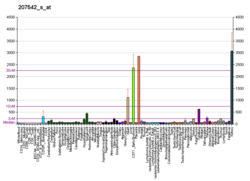
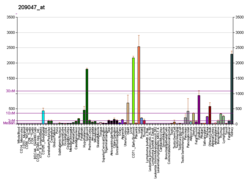
AQP1 is a widely expressed water channel, whose physiological function has been most thoroughly characterized in the kidney. It is found in the basolateral and apical plasma membranes of the proximal tubules, the descending limb of the loop of Henle, and in the descending portion of the vasa recta. Additionally, it is found in red blood cells, vascular endothelium, the gastrointestinal tract, sweat glands, lungs, and the central nervous system[5]
It is not regulated by vasopressin (ADH).
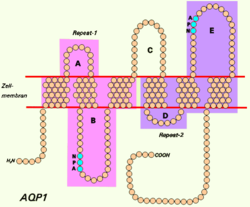
FunctionEditAquaporins are a family of small integral membrane proteins related to the major intrinsic protein (MIP or AQP0). This gene encodes an aquaporin which functions as both a molecular water channel protein and as a non-selective cation channel gated by cyclic guanosine monophosphate (cGMP).[6] It is a homotetramer with six bilayer spanning domains and N-glycosylation sites. The AQP1 monomer consists of six transmembrane alpha helices that are connected by five loops (A to E).[7] The protein physically resembles channel proteins and is abundant in erythrocytes and renal tubes. The gene encoding this aquaporin is a possible candidate for disorders involving imbalance in ocular fluid movement.[8]


