Xaa-Pro aminopeptidase 1 is an enzyme that in humans is encoded by the XPNPEP1 gene.[5]
| XPNPEP1 |
|---|
|
| Available structures |
|---|
| PDB | Ortholog search: PDBe RCSB |
|---|
|
|
| Identifiers |
|---|
| Aliases | XPNPEP1, APP1, SAMP, XPNPEP, XPNPEPL, XPNPEPL1, X-prolyl aminopeptidase (aminopeptidase P) 1, soluble, X-prolyl aminopeptidase 1 |
|---|
| External IDs | OMIM: 602443 MGI: 2180003 HomoloGene: 6424 GeneCards: XPNPEP1 |
|---|
| Gene location (Human) |
|---|
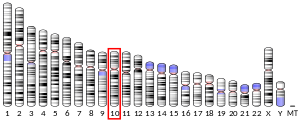 | | Chr. | Chromosome 10 (human)[1] |
|---|
| | Band | 10q25.1 | Start | 109,864,766 bp[1] |
|---|
| End | 109,923,553 bp[1] |
|---|
|
| Gene location (Mouse) |
|---|
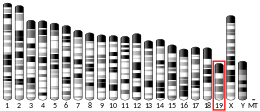 | | Chr. | Chromosome 19 (mouse)[2] |
|---|
| | Band | 19|19 D2 | Start | 52,931,926 bp[2] |
|---|
| End | 53,040,214 bp[2] |
|---|
|
| RNA expression pattern |
|---|

 | | More reference expression data |
|
| Gene ontology |
|---|
| Molecular function | • peptidase activity
• aminopeptidase activity
• hydrolase activity
• metallopeptidase activity
• protein homodimerization activity
• manganese ion binding
• metal ion binding
• metalloaminopeptidase activity
|
|---|
| Cellular component | • extracellular exosome
• cytoplasm
• cytosol
|
|---|
| Biological process | • bradykinin catabolic process
• proteolysis
|
|---|
| Sources:Amigo / QuickGO |
|
| Orthologs |
|---|
| Species | Human | Mouse |
|---|
| Entrez | | |
|---|
| Ensembl | | |
|---|
| UniProt | | |
|---|
| RefSeq (mRNA) | NM_001167604
NM_020383
NM_001324128
NM_001324131
NM_001324132
|
|---|
NM_001324133
NM_001324134
NM_001324135
NM_001324136 |
| |
|---|
| RefSeq (protein) | NP_001161076
NP_001311057
NP_001311060
NP_001311061
NP_001311062
|
|---|
NP_001311063
NP_001311064
NP_001311065
NP_065116 |
| |
|---|
| Location (UCSC) | Chr 10: 109.86 – 109.92 Mb | Chr 19: 52.93 – 53.04 Mb |
|---|
| PubMed search | [3] | [4] |
|---|
| Wikidata |
| View/Edit Human | View/Edit Mouse |
|
FunctionEditX-prolyl aminopeptidase (EC 3.4.11.9) is a proline-specific metalloaminopeptidase that specifically catalyzes the removal of any unsubstituted N-terminal amino acid that is adjacent to a penultimate proline residue. Because of its specificity toward proline, it has been suggested that X-prolyl aminopeptidase is important in the maturation and degradation of peptide hormones, neuropeptides, and tachykinins, as well as in the digestion of otherwise resistant dietary protein fragments, thereby complementing the pancreatic peptidases. Deficiency of X-prolyl aminopeptidase results in excretion of large amounts of imino-oligopeptides in urine (Blau et al., 1988).[supplied by OMIM][5]
Model organismsEditModel organisms have been used in the study of XPNPEP1 function. A conditional knockout mouse line called Xpnpep1tm1a(KOMP)Wtsi was generated at the Wellcome Trust Sanger Institute.[6] Male and female animals underwent a standardized phenotypic screen[7] to determine the effects of deletion.[8][9][10][11] Additional screens performed: - In-depth immunological phenotyping[12] - in-depth bone and cartilage phenotyping[13]
Xpnpep1 knockout mouse phenotype| Characteristic | Phenotype |
|---|
| All data available at.[7][12][13] |
| Peripheral blood leukocytes 6 Weeks | Normal |
| Haematology 6 Weeks | Normal |
| Insulin | Normal |
| Homozygous viability at P14 | Abnormal |
| Homozygous Fertility | Normal |
| Body weight | Abnormal |
| Neurological assessment | Normal |
| Grip strength | Normal |
| Dysmorphology | Normal |
| Indirect calorimetry | Abnormal |
| Glucose tolerance test | Normal |
| Auditory brainstem response | Normal |
| DEXA | Abnormal |
| Radiography | Abnormal |
| Eye morphology | Normal |
| Clinical chemistry | Abnormal |
| Haematology 16 Weeks | Normal |
| Peripheral blood leukocytes 16 Weeks | Abnormal |
| Heart weight | Normal |
| Salmonella infection | Normal |
| Cytotoxic T Cell Function | Normal |
| Spleen Immunophenotyping | Normal |
| Mesenteric Lymph Node Immunophenotyping | Normal |
| Bone Marrow Immunophenotyping | Normal |
| Epidermal Immune Composition | Normal |



