TRAF6 is a TRAF human protein.
| TRAF6 |
|---|
 |
| Available structures |
|---|
| PDB | Ortholog search: PDBe RCSB |
|---|
| List of PDB id codes |
|---|
1LB4, 1LB5, 1LB6, 2ECI, 2JMD, 3HCS, 3HCT, 3HCU, 4Z8M |
|
|
| Identifiers |
|---|
| Aliases | TRAF6, MGC:3310, RNF85, TNF receptor associated factor 6 |
|---|
| External IDs | OMIM: 602355 MGI: 108072 HomoloGene: 3395 GeneCards: TRAF6 |
|---|
| Gene location (Human) |
|---|
 | | Chr. | Chromosome 11 (human)[1] |
|---|
| | Band | 11p12 | Start | 36,483,769 bp[1] |
|---|
| End | 36,510,272 bp[1] |
|---|
|
| Gene location (Mouse) |
|---|
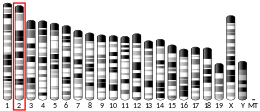 | | Chr. | Chromosome 2 (mouse)[2] |
|---|
| | Band | 2|2 E2 | Start | 101,678,429 bp[2] |
|---|
| End | 101,701,669 bp[2] |
|---|
|
| RNA expression pattern |
|---|
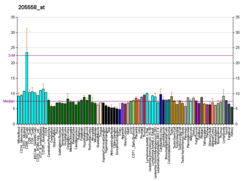 | | More reference expression data |
|
| Gene ontology |
|---|
| Molecular function | • protein N-terminus binding
• histone deacetylase binding
• GO:1904264, GO:1904822, GO:0090622, GO:0090302 ubiquitin protein ligase activity
• metal ion binding
• mitogen-activated protein kinase kinase kinase binding
• zinc ion binding
• GO:0001948 protein binding
• thioesterase binding
• ubiquitin conjugating enzyme binding
• protein kinase binding
• protein kinase B binding
• ubiquitin-protein transferase activity
• identical protein binding
• ubiquitin protein ligase binding
• transferase activity
• tumor necrosis factor receptor binding
|
|---|
| Cellular component | • cytoplasm
• cytosol
• lipid droplet
• perinuclear region of cytoplasm
• cytoplasmic side of plasma membrane
• cell nucleus
• cell membrane
• cell cortex
• endosome membrane
• CD40 receptor complex
• macromolecular complex
|
|---|
| Biological process | • positive regulation of transcription regulatory region DNA binding
• response to interleukin-1
• toll-like receptor signaling pathway
• Fc-epsilon receptor signaling pathway
• odontogenesis of dentin-containing tooth
• animal organ morphogenesis
• T-helper 1 type immune response
• toll-like receptor 9 signaling pathway
• regulation of apoptotic process
• ossification
• regulation of immunoglobulin secretion
• cytokine-mediated signaling pathway
• osteoclast differentiation
• positive regulation of osteoclast differentiation
• stimulatory C-type lectin receptor signaling pathway
• activation of NF-kappaB-inducing kinase activity
• bone resorption
• JNK cascade
• membrane protein intracellular domain proteolysis
• protein ubiquitination
• positive regulation of T cell proliferation
• I-kappaB kinase/NF-kappaB signaling
• protein autoubiquitination
• immune system process
• positive regulation of JUN kinase activity
• positive regulation of sequence-specific DNA binding transcription factor activity
• protein polyubiquitination
• negative regulation of apoptotic process
• negative regulation of transcription from RNA polymerase II promoter
• positive regulation of lipopolysaccharide-mediated signaling pathway
• activation of MAPK activity
• positive regulation of NF-kappaB transcription factor activity
• positive regulation of interleukin-2 production
• positive regulation of T cell cytokine production
• immune response
• negative regulation of transcription, DNA-templated
• nucleotide-binding oligomerization domain containing signaling pathway
• positive regulation of protein ubiquitination
• positive regulation of smooth muscle cell proliferation
• antigen processing and presentation of exogenous peptide antigen via MHC class II
• cell development
• protein K63-linked ubiquitination
• myeloid dendritic cell differentiation
• MyD88-dependent toll-like receptor signaling pathway
• neural tube closure
• bone remodeling
• positive regulation of apoptotic process
• positive regulation of I-kappaB kinase/NF-kappaB signaling
• cellular response to lipopolysaccharide
• T cell receptor signaling pathway
• activation of protein kinase activity
• positive regulation of transcription from RNA polymerase II promoter
• signal transduction
• cellular response to DNA damage stimulus
• protein deubiquitination
• regulation of I-kappaB kinase/NF-kappaB signaling
• interleukin-1-mediated signaling pathway
• cellular response to cytokine stimulus
• positive regulation of NIK/NF-kappaB signaling
• positive regulation of leukocyte adhesion to vascular endothelial cell
|
|---|
| Sources:Amigo / QuickGO |
|
| Orthologs |
|---|
| Species | Human | Mouse |
|---|
| Entrez | | |
|---|
| Ensembl | | |
|---|
| UniProt | | |
|---|
| RefSeq (mRNA) | | |
|---|
| RefSeq (protein) | | |
|---|
| Location (UCSC) | Chr 11: 36.48 – 36.51 Mb | Chr 2: 101.68 – 101.7 Mb |
|---|
| PubMed search | [3] | [4] |
|---|
| Wikidata |
| View/Edit Human | View/Edit Mouse |
|
FunctionEditThe protein encoded by this gene is a member of the TNF receptor associated factor (TRAF) protein family. TRAF proteins are associated with, and mediate signal transduction from members of the TNF receptor superfamily. This protein mediates the signaling not only from the members of the TNF receptor superfamily, but also from the members of the Toll/IL-1 family. Signals from receptors such as CD40, TNFSF11/TRANCE/RANKL and IL-1 have been shown to be mediated by this protein. This protein also interacts with various protein kinases including IRAK1/IRAK, SRC and PKCzeta, which provides a link between distinct signaling pathways. This protein functions as a signal transducer in the NF-kappaB pathway that activates IkappaB kinase (IKK) in response to proinflammatory cytokines. The interaction of this protein with UBE2N/UBC13, and UBE2V1/UEV1A, which are ubiquitin conjugating enzymes catalyzing the formation of polyubiquitin chains, has been found to be required for IKK activation by this protein. Two alternatively spliced transcript variants encoding identical proteins have been reported.[5]
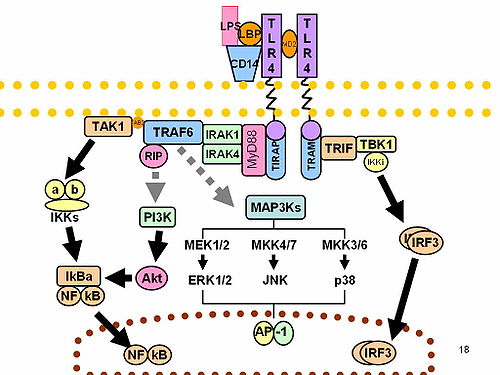
Signaling pathway of toll-like receptors. Dashed grey lines represent unknown associations
TRAF6 has been shown to interact with:
- ASK1,[6][7][8]
- CD40,[9][10]
- FHL2,[11]
- HSPB2,[12]
- IKBKG,[13][14]
- IRAK1,[15][16][17][18][19][20][21][22][23]
- IRAK2,[16][17]
- TAB1,[24][25][26]
- MAP3K7IP2,[13][23][24][25][27][28]
- MAP3K7[8][23][24][25][26][27][29]
- PPP4C,[30]
- RANK,[31][32][33][34][35]
- SDCBP,[15]
- SIGIRR,[36]
- Sequestosome 1,[37]
- TAX1BP1,[22]
- TNFAIP3,[38][39]
- TNFRSF13B,[40]
- UBE2N,[41] and
- Ubiquitin C.[14][28][30][42][43]
Model organisms have been used in the study of TRAF6 function. A conditional knockout mouse line called Traf6tm2a(EUCOMM)Wtsi was generated at the Wellcome Trust Sanger Institute.[44] Male and female animals underwent a standardized phenotypic screen[45] to determine the effects of deletion.[46][47][48][49] Additional screens performed: - In-depth immunological phenotyping[50]
Traf6 knockout mouse phenotype| Characteristic | Phenotype |
|---|
| All data available at.[45][50] |
| Peripheral blood leukocytes 6 Weeks | Normal |
| Insulin | Normal |
| Haematology 6 Weeks | Normal |
| Homozygous viability at P14 | Abnormal |
| Recessive lethal study | Abnormal |
| Body weight | Normal |
| Neurological assessment | Normal |
| Grip strength | Normal |
| Dysmorphology | Normal |
| Indirect calorimetry | Normal |
| Glucose tolerance test | Normal |
| Auditory brainstem response | Normal |
| DEXA | Normal |
| Radiography | Normal |
| Eye morphology | Normal |
| Clinical chemistry | Normal |
| Haematology 16 Weeks | Normal |
| Peripheral blood leukocytes 16 Weeks | Normal |
| Heart weight | Normal |
| Salmonella infection | Normal |
| Cytotoxic T Cell Function | Normal |
| Spleen Immunophenotyping | Normal |
| Mesenteric Lymph Node Immunophenotyping | Normal |
| Epidermal Immune Composition | Normal |



