Signal transducer and activator of transcription 3 (STAT3) is a transcription factor which in humans is encoded by the STAT3 gene.[5] It is a member of the STAT protein family.
| STAT3 |
|---|
 |
| Available structures |
|---|
| PDB | Ortholog search: PDBe RCSB |
|---|
|
|
| Identifiers |
|---|
| Aliases | STAT3, ADMIO, APRF, HIES, signal transducer and activator of transcription 3, ADMIO1 |
|---|
| External IDs | OMIM: 102582 MGI: 103038 HomoloGene: 7960 GeneCards: STAT3 |
|---|
| Gene location (Human) |
|---|
 | | Chr. | Chromosome 17 (human)[1] |
|---|
| | Band | 17q21.2 | Start | 42,313,324 bp[1] |
|---|
| End | 42,388,568 bp[1] |
|---|
|
| Gene location (Mouse) |
|---|
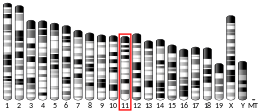 | | Chr. | Chromosome 11 (mouse)[2] |
|---|
| | Band | 11 D|11 63.82 cM | Start | 100,885,098 bp[2] |
|---|
| End | 100,939,540 bp[2] |
|---|
|
| RNA expression pattern |
|---|
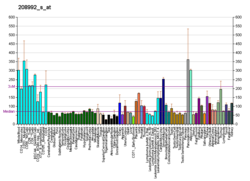
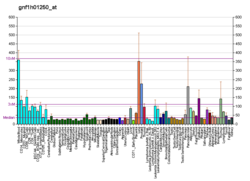
 | | More reference expression data |
|
| Gene ontology |
|---|
| Molecular function | • protein dimerization activity
• GO:0001131, GO:0001151, GO:0001130, GO:0001204 DNA-binding transcription factor activity
• GO:0001077, GO:0001212, GO:0001213, GO:0001211, GO:0001205 DNA-binding transcription activator activity, RNA polymerase II-specific
• GO:0038050, GO:0004886, GO:0038051 nuclear receptor activity
• protein phosphatase binding
• GO:0000980 RNA polymerase II cis-regulatory region sequence-specific DNA binding
• GO:0001948 protein binding
• protein kinase binding
• DNA binding
• sequence-specific DNA binding
• RNA polymerase II repressing transcription factor binding
• chromatin DNA binding
• protein homodimerization activity
• identical protein binding
• GO:0001200, GO:0001133, GO:0001201 DNA-binding transcription factor activity, RNA polymerase II-specific
• signal transducer activity
• transcription factor binding
• CCR5 chemokine receptor binding
• glucocorticoid receptor binding
|
|---|
| Cellular component | • cytoplasm
• mitochondrion
• cell nucleus
• nuclear chromatin
• cell membrane
• nucleoplasm
• RNA polymerase II transcription factor complex
• mitochondrial inner membrane
• cytosol
• GO:0097483, GO:0097481 postsynaptic density
• Schaffer collateral - CA1 synapse
• glutamatergic synapse
• transcription regulator complex
|
|---|
| Biological process | • negative regulation of glycolytic process
• protein import into nucleus
• regulation of transcription from RNA polymerase II promoter
• transcription from RNA polymerase II promoter
• response to organic substance
• positive regulation of gene silencing by miRNA
• radial glial cell differentiation
• stem cell population maintenance
• cellular response to hormone stimulus
• regulation of mitochondrial membrane permeability
• growth hormone receptor signaling pathway
• miRNA mediated inhibition of translation
• eye photoreceptor cell differentiation
• positive regulation of metalloendopeptidase activity
• temperature homeostasis
• cellular proliferation
• response to leptin
• response to ethanol
• positive regulation of Notch signaling pathway
• negative regulation of cell proliferation
• response to cytokine
• regulation of transcription, DNA-templated
• glucose homeostasis
• negative regulation of cell death
• transcription, DNA-templated
• positive regulation of growth factor dependent skeletal muscle satellite cell proliferation
• positive regulation of transcription, DNA-templated
• negative regulation of hydrogen peroxide biosynthetic process
• energy homeostasis
• GO:0022415 viral process
• negative regulation of neuron death
• sexual reproduction
• phosphorylation
• leptin-mediated signaling pathway
• cellular response to organic cyclic compound
• negative regulation of apoptotic process
• negative regulation of transcription from RNA polymerase II promoter
• regulation of feeding behavior
• nervous system development
• positive regulation of ATP biosynthetic process
• intracellular receptor signaling pathway
• acute-phase response
• negative regulation of neuron migration
• JAK-STAT cascade
• response to estradiol
• response to organic cyclic compound
• eating behavior
• somatic stem cell population maintenance
• regulation of multicellular organism growth
• aging
• response to peptide hormone
• cellular response to leptin stimulus
• regulation of cell cycle
• astrocyte differentiation
• response to drug
• signal transduction
• positive regulation of transcription from RNA polymerase II promoter
• JAK-STAT cascade involved in growth hormone signaling pathway
• positive regulation of gene expression
• negative regulation of stem cell differentiation
• positive regulation of cell proliferation
• mRNA transcription from RNA polymerase II promoter
• inflammatory response
• positive regulation of erythrocyte differentiation
• T-helper 17 cell lineage commitment
• positive regulation of pri-miRNA transcription from RNA polymerase II promoter
• positive regulation of tyrosine phosphorylation of STAT protein
• interleukin-15-mediated signaling pathway
• interleukin-7-mediated signaling pathway
• positive regulation of angiogenesis
• positive regulation of vascular endothelial cell proliferation
• cytokine-mediated signaling pathway
• interleukin-21-mediated signaling pathway
• interleukin-23-mediated signaling pathway
• interleukin-6-mediated signaling pathway
• interleukin-27-mediated signaling pathway
• interleukin-35-mediated signaling pathway
• cellular response to cytokine stimulus
• interleukin-9-mediated signaling pathway
• modulation of chemical synaptic transmission
• postsynapse to nucleus signaling pathway
• negative regulation of autophagy
• positive regulation of cell migration
• positive regulation of NF-kappaB transcription factor activity
• defense response
• regulation of cell proliferation
|
|---|
| Sources:Amigo / QuickGO |
|
| Orthologs |
|---|
| Species | Human | Mouse |
|---|
| Entrez | | |
|---|
| Ensembl | | |
|---|
| UniProt | | |
|---|
| RefSeq (mRNA) | NM_003150
NM_139276
NM_213662
NM_001369512
NM_001369513
|
|---|
NM_001369514
NM_001369516
NM_001369517
NM_001369518
NM_001369519
NM_001369520 |
| |
|---|
NM_011486
NM_213659
NM_213660 |
|
|---|
| RefSeq (protein) | NP_003141
NP_644805
NP_998827
NP_001356441
NP_001356442
|
|---|
NP_001356443
NP_001356445
NP_001356446
NP_001356447
NP_001356448
NP_001356449 |
| |
|---|
NP_035616
NP_998824
NP_998825 |
|
|---|
| Location (UCSC) | Chr 17: 42.31 – 42.39 Mb | Chr 11: 100.89 – 100.94 Mb |
|---|
| PubMed search | [3] | [4] |
|---|
| Wikidata |
| View/Edit Human | View/Edit Mouse |
|
FunctionEditSTAT3 is a member of the STAT protein family. In response to cytokines and growth factors, STAT3 is phosphorylated by receptor-associated Janus kinases (JAK), form homo- or heterodimers, and translocate to the cell nucleus where they act as transcription activators. Specifically, STAT3 becomes activated after phosphorylation of tyrosine 705 in response to such ligands as interferons, epidermal growth factor (EGF), Interleukin (IL-)5 and IL-6. Additionally, activation of STAT3 may occur via phosphorylation of serine 727 by Mitogen-activated protein kinases (MAPK)[6] and through c-src non-receptor tyrosine kinase.[7][8] STAT3 mediates the expression of a variety of genes in response to cell stimuli, and thus plays a key role in many cellular processes such as cell growth and apoptosis.[9]
STAT3-deficient mouse embryos cannot develop beyond embryonic day 7, when gastrulation begins.[10] It appears that at these early stages of development, STAT3 activation is required for self-renewal of embryonic stem cells (ESCs). Indeed, LIF, which is supplied to murine ESC cultures to maintain their undifferentiated state, can be omitted if STAT3 is activated through some other means.[11]
STAT3 is essential for the differentiation of the TH17 helper T cells, which have been implicated in a variety of autoimmune diseases.[12] During viral infection, mice lacking STAT3 in T-cells display impairment in the ability to generate T-follicular helper (Tfh) cells and fail to maintain antibody based immunity.[13]
Clinical significanceEditLoss-of-function mutations in the STAT3 gene result in Hyperimmunoglobulin E syndrome, associated with recurrent infections as well as disordered bone and tooth development.[14]
Gain-of-function mutations in the STAT3 gene have been reported to cause multi-organ early onset auto-immune diseases; such as thyroid disease, diabetes, intestinal inflammation, and low blood counts,[15] while constitutive STAT3 activation is associated with various human cancers and commonly suggests poor prognosis.[16][17][18][19] It has anti-apoptotic as well as proliferative effects.[16]
STAT3 can promote oncogenesis by being constitutively active through various pathways as mentioned elsewhere. A tumor suppressor role of STAT3 has also been reported.[20][21][22] In the report on human glioblastoma tumor, or brain cancer, STAT3 was shown to have an oncogenic or a tumor suppressor role depending upon the mutational background of the tumor. A direct connection between the PTEN-Akt-FOXO axis (suppressive) and the leukemia inhibitory factor receptor beta (LIFRbeta)-STAT3 signaling pathway (oncogenic) was shown.
Increased activity of STAT3 in cancer cells, leads to changes in the function of protein complexes that control expression of inflammatory genes, with result profound change in the secretome and the cell phenotypes, their activity in the tumor, and their capacity for metastasis.[23]
InteractionsEditSTAT3 has been shown to interact with:
- AR,[24][25]
- ELP2,[26]
- EP300,[27]
- EGFR,[28][29]
- HIF1A,[30]
- JAK1,[24][31]
- JUN[32]
- KHDRBS1,[33]
- mTOR,[34][35]
- MYOD1,[36]
- NDUFA13,[37]
- NFKB1,[38]
- NR3C1,[39][40]
- NCOA1,[41]
- PML,[42]
- RAC1,[43]
- RELA,[38]
- RET,[28][44][45]
- RPA2,[46]
- STAT1,[31][47][48]
- Stathmin,[49]
- Src,[50] and
- TRIP10.[51]
- KPNA4.[52]
Niclosamide seems to inhibit the STAT3 signalling pathway.[53]



