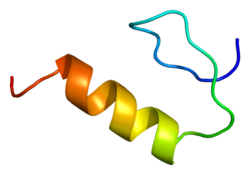
Transcription factor Sp1, also known as specificity protein 1* is a protein that in humans is encoded by the SP1 gene.[5]
| SP1 |
|---|
 |
| Available structures |
|---|
| PDB | Ortholog search: PDBe RCSB |
|---|
| List of PDB id codes |
|---|
1SP1, 1SP2, 1VA1, 1VA2, 1VA3 |
|
|
| Identifiers |
|---|
| Aliases | SP1, entrez:6667, Sp1 transcription factor |
|---|
| External IDs | OMIM: 189906 MGI: 98372 HomoloGene: 8276 GeneCards: SP1 |
|---|
| Gene location (Human) |
|---|
 | | Chr. | Chromosome 12 (human)[1] |
|---|
| | Band | 12q13.13 | Start | 53,380,176 bp[1] |
|---|
| End | 53,416,446 bp[1] |
|---|
|
| Gene location (Mouse) |
|---|
 | | Chr. | Chromosome 15 (mouse)[2] |
|---|
| | Band | 15|15 F3 | Start | 102,406,143 bp[2] |
|---|
| End | 102,436,404 bp[2] |
|---|
|
| RNA expression pattern |
|---|
 | | More reference expression data |
|
| Gene ontology |
|---|
| Molecular function | • protein homodimerization activity
• HMG box domain binding
• transcription factor binding
• histone deacetylase binding
• metal ion binding
• transcription factor activity, RNA polymerase II core promoter proximal region sequence-specific binding
• bHLH transcription factor binding
• protein C-terminus binding
• GO:0001948 protein binding
• histone acetyltransferase binding
• RNA polymerase II repressing transcription factor binding
• nucleic acid binding
• sequence-specific DNA binding
• RNA polymerase II regulatory region sequence-specific DNA binding
• DNA binding
• double-stranded DNA binding
• GO:0001077, GO:0001212, GO:0001213, GO:0001211, GO:0001205 DNA-binding transcription activator activity, RNA polymerase II-specific
• repressing transcription factor binding
• GO:0001131, GO:0001151, GO:0001130, GO:0001204 DNA-binding transcription factor activity
• GO:0000980 RNA polymerase II cis-regulatory region sequence-specific DNA binding
• core promoter sequence-specific DNA binding
• GO:0001200, GO:0001133, GO:0001201 DNA-binding transcription factor activity, RNA polymerase II-specific
• GO:0001158 core promoter proximal region sequence-specific DNA binding
|
|---|
| Cellular component | • cytoplasm
• nucleoplasm
• protein-DNA complex
• cell nucleus
• nuclear chromatin
• transcriptional repressor complex
|
|---|
| Biological process | • positive regulation of hydrogen sulfide biosynthetic process
• rhythmic process
• regulation of transcription from RNA polymerase II promoter
• positive regulation of transcription, DNA-templated
• GO:0022415 viral process
• regulation of transcription, DNA-templated
• transcription, DNA-templated
• snRNA transcription from RNA polymerase II promoter
• cellular response to insulin stimulus
• positive regulation of transcription from RNA polymerase II promoter
• regulation of cholesterol biosynthetic process
• positive regulation of gene expression
• positive regulation of blood vessel endothelial cell migration
• positive regulation of angiogenesis
• positive regulation of vascular endothelial cell proliferation
• response to hydroperoxide
|
|---|
| Sources:Amigo / QuickGO |
|
| Orthologs |
|---|
| Species | Human | Mouse |
|---|
| Entrez | | |
|---|
| Ensembl | | |
|---|
| UniProt | | |
|---|
| RefSeq (mRNA) | |
|---|
NM_001251825
NM_003109
NM_138473 |
| |
|---|
| RefSeq (protein) | |
|---|
NP_001238754
NP_003100
NP_612482 |
| |
|---|
| Location (UCSC) | Chr 12: 53.38 – 53.42 Mb | Chr 15: 102.41 – 102.44 Mb |
|---|
| PubMed search | [3] | [4] |
|---|
| Wikidata |
| View/Edit Human | View/Edit Mouse |
|
FunctionEditThe protein encoded by this gene is a zinc finger transcription factor that binds to GC-rich motifs of many promoters. The encoded protein is involved in many cellular processes, including cell differentiation, cell growth, apoptosis, immune responses, response to DNA damage, and chromatin remodeling. Post-translational modifications such as phosphorylation, acetylation, O-GlcNAcylation, and proteolytic processing significantly affect the activity of this protein, which can be an activator or a repressor.[5]
In the SV40 virus, Sp1 binds to the GC boxes in the regulatory region (RR) of the genome.
StructureEditSP1 belongs to the Sp/KLF family of transcription factors. The protein is 785 amino acids long, with a molecular weight of 81 kDa. The SP1 transcription factor contains a zinc finger protein motif, by which it binds directly to DNA and enhances gene transcription. Its zinc fingers are of the Cys2/His2 type and bind the consensus sequence 5'-(G/T)GGGCGG(G/A)(G/A)(C/T)-3' (GC box element). Some 12,000 SP-1 binding sites are found in the human genome.[6]
ApplicationsEditSp1 has been used as a control protein to compare with when studying the increase or decrease of the aryl hydrocarbon receptor and/or the estrogen receptor, since it binds to both and generally remains at a relatively constant level.[7]
InhibitorsEditPlicamycin, an antineoplastic antibiotic produced by Streptomyces plicatus, and Withaferin A, a steroidal lactone from Withania somnifera plant are known to inhibit Sp1 transcription factor.[8][9]
miR-375-5p microRNA significantly decreased expression of SP1 and YAP1 in colorectal cancer cells. SP1 and YAP1 mRNAs are direct targets of miR-375-5p.[10]



