PYCARD, often referred to as ASC (Apoptosis-associated speck-like protein containing a CARD), is a protein that in humans is encoded by the PYCARD gene.[5] It is localized mainly in the nucleus of monocytes and macrophages. In case of pathogen infection, however, it relocalizes rapidly to the cytoplasm, perinuclear space, endoplasmic reticulum and mitochondria and it is a key adaptor protein in activation of the inflammasome.[6]
| PYCARD |
|---|
 |
| Available structures |
|---|
| PDB | Ortholog search: PDBe RCSB |
|---|
| List of PDB id codes |
|---|
1UCP, 2KN6, 3J63, 5H8O |
|
|
| Identifiers |
|---|
| Aliases | PYCARD, ASC, CARD5, TMS, TMS-1, TMS1, PYD and CARD domain containing |
|---|
| External IDs | OMIM: 606838 MGI: 1931465 HomoloGene: 8307 GeneCards: PYCARD |
|---|
| Gene location (Human) |
|---|
 | | Chr. | Chromosome 16 (human)[1] |
|---|
| | Band | 16p11.2 | Start | 31,201,486 bp[1] |
|---|
| End | 31,203,450 bp[1] |
|---|
|
| Gene location (Mouse) |
|---|
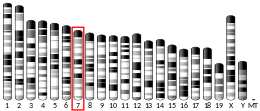 | | Chr. | Chromosome 7 (mouse)[2] |
|---|
| | Band | 7|7 F3 | Start | 127,989,708 bp[2] |
|---|
| End | 127,993,867 bp[2] |
|---|
|
| RNA expression pattern |
|---|
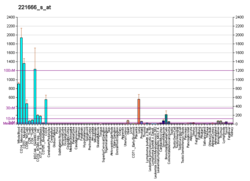 | | More reference expression data |
|
| Gene ontology |
|---|
| Molecular function | • protein homodimerization activity
• interleukin-6 receptor binding
• BMP receptor binding
• GO:0001948 protein binding
• identical protein binding
• enzyme binding
• cysteine-type endopeptidase activity involved in apoptotic process
• Pyrin domain binding
• cysteine-type endopeptidase activator activity involved in apoptotic process
• myosin I binding
• tropomyosin binding
• protease binding
• ion channel binding
• protein dimerization activity
• cysteine-type endopeptidase activity
|
|---|
| Cellular component | • cytoplasm
• NLRP3 inflammasome complex
• NLRP1 inflammasome complex
• AIM2 inflammasome complex
• nucleolus
• endoplasmic reticulum
• mitochondrion
• IkappaB kinase complex
• cell nucleus
• secretory granule lumen
• azurophil granule lumen
• extracellular region
• cytosol
• macromolecular complex
• neuronal cell body
• Golgi membrane
• Golgi apparatus
• membrane
|
|---|
| Biological process | • positive regulation of cysteine-type endopeptidase activity
• regulation of apoptotic process
• intrinsic apoptotic signaling pathway in response to DNA damage by p53 class mediator
• regulation of intrinsic apoptotic signaling pathway
• intrinsic apoptotic signaling pathway by p53 class mediator
• positive regulation of adaptive immune response
• defense response to Gram-negative bacterium
• immune system process
• cellular response to tumor necrosis factor
• regulation of tumor necrosis factor-mediated signaling pathway
• positive regulation of sequence-specific DNA binding transcription factor activity
• tumor necrosis factor-mediated signaling pathway
• positive regulation of JNK cascade
• negative regulation of interferon-beta production
• negative regulation of I-kappaB kinase/NF-kappaB signaling
• myeloid dendritic cell activation
• positive regulation of T cell activation
• defense response to virus
• cellular response to interleukin-1
• positive regulation of apoptotic process
• positive regulation of tumor necrosis factor production
• positive regulation of release of cytochrome c from mitochondria
• negative regulation of protein serine/threonine kinase activity
• positive regulation of extrinsic apoptotic signaling pathway
• inflammatory response
• cellular response to lipopolysaccharide
• negative regulation of NF-kappaB transcription factor activity
• signal transduction
• apoptotic process
• innate immune system
• neutrophil degranulation
• positive regulation of NF-kappaB transcription factor activity
• activation of innate immune response
• myeloid dendritic cell activation involved in immune response
• positive regulation of antigen processing and presentation of peptide antigen via MHC class II
• activation of cysteine-type endopeptidase activity involved in apoptotic process
• positive regulation of actin filament polymerization
• regulation of protein stability
• positive regulation of interferon-gamma production
• positive regulation of interleukin-6 production
• positive regulation of activated T cell proliferation
• positive regulation of cysteine-type endopeptidase activity involved in apoptotic process
• macropinocytosis
• positive regulation of phagocytosis
• positive regulation of ERK1 and ERK2 cascade
• positive regulation of T cell migration
• positive regulation of defense response to virus by host
• intrinsic apoptotic signaling pathway in response to DNA damage
• response to bacterium
• regulation of autophagy
• interleukin-1 beta production
• GO:0043087, GO:0032313, GO:0032319, GO:0032314, GO:0043088 regulation of GTPase activity
• regulation of cysteine-type endopeptidase activity involved in apoptotic process
• regulation of inflammatory response
• protein homooligomerization
• activation of cysteine-type endopeptidase activity
• negative regulation of cytokine production involved in inflammatory response
• proteolysis
• positive regulation of interleukin-1 beta production
|
|---|
| Sources:Amigo / QuickGO |
|
| Orthologs |
|---|
| Species | Human | Mouse |
|---|
| Entrez | | |
|---|
| Ensembl | | |
|---|
| UniProt | | |
|---|
| RefSeq (mRNA) | |
|---|
NM_145183
NM_013258
NM_145182 |
| |
|---|
| RefSeq (protein) | | |
|---|
| Location (UCSC) | Chr 16: 31.2 – 31.2 Mb | Chr 7: 127.99 – 127.99 Mb |
|---|
| PubMed search | [3] | [4] |
|---|
| Wikidata |
| View/Edit Human | View/Edit Mouse |
|
NMR structure of full-length ASC: PDB ID 2KN6 [1][7]
FunctionEditThis gene encodes an adaptor protein that is composed of two protein–protein interaction domains: a N-terminal PYRIN-PAAD-DAPIN domain (PYD) and a C-terminal caspase-recruitment domain (CARD). The PYD and CARD domains are members of the six-helix bundle death domain-fold superfamily that mediates assembly of large signaling complexes in the inflammatory and apoptotic signaling pathways via the activation of caspase. In normal cells, this protein is localized to the cytoplasm; however, in cells undergoing apoptosis, it forms ball-like aggregates near the nuclear periphery.
PYCARD can occur in four different isoforms. Isoform 1, often referred to as canonical PYCARD, and isoform 2 are the activatory isoforms. They co-localize with nucleotide oligomerization domain-like receptors (NLRs) and caspase-1. Unlike isoform 1, isoform 2 is involved in direct IL-1β processing regulation. Isoform 3 is an inhibitory isoform, so that it only co-localizes with caspase-1, but not with NLRs. Isoform 4 is not able to act as an adaptor protein in NLR signalling and its role remains elusive.[6]
InteractionsEditPYCARD has been shown to interact with MEFV.[8]



