cAMP-specific 3',5'-cyclic phosphodiesterase 4A is an enzyme that in humans is encoded by the PDE4A gene.[5][6]
| PDE4A |
|---|
 |
| Available structures |
|---|
| PDB | Ortholog search: PDBe RCSB |
|---|
| List of PDB id codes |
|---|
2QYK, 3I8V, 3TVX |
|
|
| Identifiers |
|---|
| Aliases | PDE4A, DPDE2, PDE4, PDE46, phosphodiesterase 4A |
|---|
| External IDs | OMIM: 600126 MGI: 99558 HomoloGene: 4520 GeneCards: PDE4A |
|---|
| Gene location (Human) |
|---|
 | | Chr. | Chromosome 19 (human)[1] |
|---|
| | Band | 19p13.2 | Start | 10,416,773 bp[1] |
|---|
| End | 10,469,630 bp[1] |
|---|
|
| Gene location (Mouse) |
|---|
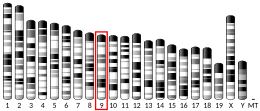 | | Chr. | Chromosome 9 (mouse)[2] |
|---|
| | Band | 9 A3|9 7.73 cM | Start | 21,165,714 bp[2] |
|---|
| End | 21,213,248 bp[2] |
|---|
|
| RNA expression pattern |
|---|
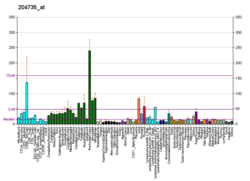
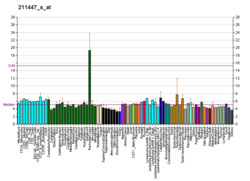
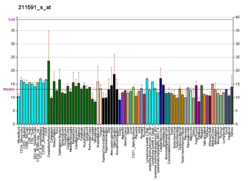 | | More reference expression data |
|
| Gene ontology |
|---|
| Molecular function | • phosphoric diester hydrolase activity
• cAMP binding
• GO:0001948 protein binding
• hydrolase activity
• 3',5'-cyclic-nucleotide phosphodiesterase activity
• metal ion binding
• 3',5'-cyclic-AMP phosphodiesterase activity
|
|---|
| Cellular component | • cytoplasm
• ruffle membrane
• perinuclear region of cytoplasm
• cytosol
• cell projection
• membrane
• nucleoplasm
• cell membrane
|
|---|
| Biological process | • sensory perception of smell
• regulation of cAMP-mediated signaling
• cellular response to drug
• cAMP catabolic process
• regulation of protein kinase A signaling
• signal transduction
• G-protein coupled receptor signaling pathway
|
|---|
| Sources:Amigo / QuickGO |
|
| Orthologs |
|---|
| Species | Human | Mouse |
|---|
| Entrez | | |
|---|
| Ensembl | | |
|---|
| UniProt | | |
|---|
| RefSeq (mRNA) | |
|---|
NM_001111307
NM_001111308
NM_001111309
NM_001243121
NM_006202 |
| |
|---|
NM_019798
NM_183408
NM_001310750 |
|
|---|
| RefSeq (protein) | |
|---|
NP_001104777
NP_001104778
NP_001104779
NP_001230050
NP_006193 |
| |
|---|
NP_001297679
NP_062772
NP_899668 |
|
|---|
| Location (UCSC) | Chr 19: 10.42 – 10.47 Mb | Chr 9: 21.17 – 21.21 Mb |
|---|
| PubMed search | [3] | [4] |
|---|
| Wikidata |
| View/Edit Human | View/Edit Mouse |
|
FunctionEditThe protein encoded by this gene belongs to the cyclic nucleotide phosphodiesterase (PDE) family, and PDE4 subfamily. This PDE hydrolyzes the secondary messenger, cAMP, which is a regulator and mediator of a number of cellular responses to extracellular signals. Thus, by regulating the cellular concentration of cAMP, this protein plays a key role in many important physiological processes.[6] Recently, it has been shown through the use of PDE4A knock out mice that PDE4A may play a role in the regulation of anxiety and emotional memory.[7]



