Osteoglycin (also called mimecan), encoded by the OGN gene, is a human protein.[5]
| OGN |
|---|
|
| Identifiers |
|---|
| Aliases | OGN, OG, OIF, SLRR3A, osteoglycin |
|---|
| External IDs | OMIM: 602383 MGI: 109278 HomoloGene: 8542 GeneCards: OGN |
|---|
| Gene location (Human) |
|---|
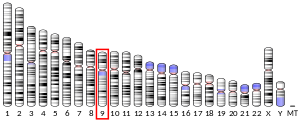 | | Chr. | Chromosome 9 (human)[1] |
|---|
| | Band | 9q22.31 | Start | 92,383,268 bp[1] |
|---|
| End | 92,404,696 bp[1] |
|---|
|
| Gene location (Mouse) |
|---|
 | | Chr. | Chromosome 13 (mouse)[2] |
|---|
| | Band | 13|13 A5 | Start | 49,608,046 bp[2] |
|---|
| End | 49,624,501 bp[2] |
|---|
|
| RNA expression pattern |
|---|
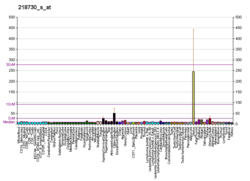 | | More reference expression data |
|
| Gene ontology |
|---|
| Molecular function | • GO:0001948 protein binding
• growth factor activity
• extracellular matrix structural constituent conferring compression resistance
|
|---|
| Cellular component | • extracellular vesicle
• extracellular matrix
• lysosomal lumen
• Golgi lumen
• extracellular exosome
• extracellular
• extracellular region
• collagen-containing extracellular matrix
|
|---|
| Biological process | • negative regulation of smooth muscle cell proliferation
• axonogenesis
• keratan sulfate catabolic process
• keratan sulfate biosynthetic process
• regulation of receptor activity
• signal transduction
|
|---|
| Sources:Amigo / QuickGO |
|
| Orthologs |
|---|
| Species | Human | Mouse |
|---|
| Entrez | | |
|---|
| Ensembl | | |
|---|
| UniProt | | |
|---|
| RefSeq (mRNA) | |
|---|
NM_033014
NM_014057
NM_024416 |
| |
|---|
| RefSeq (protein) | |
|---|
NP_054776
NP_077727
NP_148935
NP_054776.1
NP_148935.1 |
| |
|---|
| Location (UCSC) | Chr 9: 92.38 – 92.4 Mb | Chr 13: 49.61 – 49.62 Mb |
|---|
| PubMed search | [3] | [4] |
|---|
| Wikidata |
| View/Edit Human | View/Edit Mouse |
|
This gene encodes a protein which induces ectopic bone formation in conjunction with transforming growth factor beta. This protein is a small keratan sulfate proteoglycan[6] which contains tandem leucine-rich repeats (LRR). The gene expresses three transcript variants.[5]
The level of expression of this gene has been correlated with enlarged hearts and more specifically left ventricular hypertrophy.[7][8]


