Notch homolog 1, translocation-associated (Drosophila), also known as NOTCH1, is a human gene encoding a single-pass transmembrane receptor.
| NOTCH1 |
|---|
 |
| Available structures |
|---|
| PDB | Ortholog search: PDBe RCSB |
|---|
| List of PDB id codes |
|---|
1PB5, 1TOZ, 1YYH, 2F8X, 2F8Y, 2HE0, 2VJ3, 3ETO, 3I08, 3L95, 3NBN, 3V79, 4CUD, 4CUE, 4CUF, 4D0E, 4D0F, 5FM9, 5FMA |
|
|
| Identifiers |
|---|
| Aliases | NOTCH1, Notch1, 9930111A19Rik, Mis6, N1, Tan1, lin-12, AOS5, AOVD1, hN1, notch 1, notch receptor 1 |
|---|
| External IDs | OMIM: 190198 MGI: 97363 HomoloGene: 32049 GeneCards: NOTCH1 |
|---|
| Gene location (Human) |
|---|
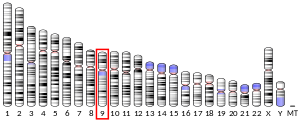 | | Chr. | Chromosome 9 (human)[1] |
|---|
| | Band | 9q34.3 | Start | 136,494,433 bp[1] |
|---|
| End | 136,546,048 bp[1] |
|---|
|
| Gene location (Mouse) |
|---|
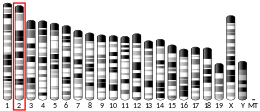 | | Chr. | Chromosome 2 (mouse)[2] |
|---|
| | Band | 2 A3|2 18.91 cM | Start | 26,457,903 bp[2] |
|---|
| End | 26,516,663 bp[2] |
|---|
|
| RNA expression pattern |
|---|
 | | More reference expression data |
|
| Gene ontology |
|---|
| Molecular function | • calcium ion binding
• GO:0001131, GO:0001151, GO:0001130, GO:0001204 DNA-binding transcription factor activity
• Notch binding
• GO:0048551 enzyme inhibitor activity
• metal ion binding
• enzyme binding
• chromatin binding
• GO:0001948 protein binding
• sequence-specific DNA binding
• protein heterodimerization activity
• chromatin DNA binding
• transmembrane signaling receptor activity
• signaling receptor activity
• GO:0000980 RNA polymerase II cis-regulatory region sequence-specific DNA binding
• GO:0001077, GO:0001212, GO:0001213, GO:0001211, GO:0001205 DNA-binding transcription activator activity, RNA polymerase II-specific
|
|---|
| Cellular component | • cytoplasm
• cytosol
• membrane
• adherens junction
• extracellular region
• cell nucleus
• cell surface
• apical plasma membrane
• endoplasmic reticulum
• integral component of membrane
• Golgi apparatus
• receptor complex
• cell membrane
• nucleoplasm
• MAML1-RBP-Jkappa- ICN1 complex
• cell periphery
• endoplasmic reticulum membrane
• Golgi membrane
• Acrosome
• cytoplasmic vesicle
|
|---|
| Biological process | • cardiac vascular smooth muscle cell development
• endoderm development
• pulmonary valve morphogenesis
• positive regulation of endothelial cell differentiation
• regulation of somitogenesis
• cell differentiation in spinal cord
• negative regulation of neuron differentiation
• regulation of extracellular matrix assembly
• distal tubule development
• negative regulation of glial cell proliferation
• epithelial to mesenchymal transition involved in endocardial cushion formation
• regulation of transcription from RNA polymerase II promoter
• aortic valve morphogenesis
• oligodendrocyte differentiation
• endocardium morphogenesis
• negative regulation of osteoblast differentiation
• negative regulation of stem cell differentiation
• negative regulation of ossification
• heart looping
• negative regulation of photoreceptor cell differentiation
• arterial endothelial cell differentiation
• regulation of transcription from RNA polymerase II promoter involved in myocardial precursor cell differentiation
• atrioventricular valve morphogenesis
• Notch signaling pathway involved in regulation of secondary heart field cardioblast proliferation
• humoral immune response
• foregut morphogenesis
• negative regulation of oligodendrocyte differentiation
• positive regulation of cardiac muscle cell proliferation
• regulation of developmental process
• mesenchymal cell development
• animal organ regeneration
• angiogenesis
• spermatogenesis
• negative regulation of pro-B cell differentiation
• regulation of cardioblast proliferation
• hair follicle morphogenesis
• vasculogenesis involved in coronary vascular morphogenesis
• negative regulation of canonical Wnt signaling pathway
• regulation of neurogenesis
• negative regulation of cell proliferation
• collecting duct development
• positive regulation of neuroblast proliferation
• cilium morphogenesis
• heart trabecula morphogenesis
• atrioventricular node development
• negative regulation of myoblast differentiation
• cell fate commitment
• regulation of transcription, DNA-templated
• cellular response to follicle-stimulating hormone stimulus
• lung development
• negative regulation of auditory receptor cell differentiation
• cardiac septum morphogenesis
• ventricular septum morphogenesis
• negative regulation of cell differentiation
• coronary artery morphogenesis
• response to muramyl dipeptide
• cardiac left ventricle morphogenesis
• in utero embryonic development
• negative regulation of cell death
• endocardial cell differentiation
• transcription, DNA-templated
• positive regulation of transcription, DNA-templated
• heart development
• prostate gland epithelium morphogenesis
• embryonic limb morphogenesis
• growth involved in heart morphogenesis
• neural tube development
• pericardium morphogenesis
• epidermis development
• cardiac atrium morphogenesis
• transcription initiation from RNA polymerase II promoter
• cardiac right atrium morphogenesis
• negative regulation of cell-substrate adhesion
• cell migration involved in endocardial cushion formation
• cell differentiation
• venous endothelial cell differentiation
• regulation of auditory receptor cell differentiation
• GO:0048553 negative regulation of catalytic activity
• inflammatory response to antigenic stimulus
• positive regulation of astrocyte differentiation
• positive regulation of epithelial cell proliferation
• cardiac right ventricle formation
• endocardial cushion development
• cell fate specification
• positive regulation of keratinocyte differentiation
• positive regulation of glial cell differentiation
• negative regulation of neurogenesis
• glomerular mesangial cell development
• sprouting angiogenesis
• glial cell differentiation
• negative regulation of transcription from RNA polymerase II promoter
• cardiac muscle cell proliferation
• secretory columnal luminar epithelial cell differentiation involved in prostate glandular acinus development
• positive regulation of epithelial to mesenchymal transition
• ventricular trabecula myocardium morphogenesis
• neuronal stem cell population maintenance
• negative regulation of cell migration involved in sprouting angiogenesis
• response to lipopolysaccharide
• compartment pattern specification
• immune response
• neuron differentiation
• epithelial–mesenchymal transition
• positive regulation of BMP signaling pathway
• skeletal muscle cell differentiation
• regulation of gene expression
• positive regulation of viral genome replication
• regulation of epithelial cell proliferation involved in prostate gland development
• negative regulation of transcription, DNA-templated
• cardiac ventricle morphogenesis
• branching morphogenesis of an epithelial tube
• positive regulation of JAK-STAT cascade
• negative regulation of anoikis
• Notch signaling involved in heart development
• coronary vein morphogenesis
• apoptotic process involved in embryonic digit morphogenesis
• regulation of cell migration
• axonogenesis
• tissue regeneration
• positive regulation of cell migration
• somatic stem cell division
• cardiac muscle tissue morphogenesis
• negative regulation of endothelial cell chemotaxis
• keratinocyte differentiation
• negative regulation of BMP signaling pathway
• endocardial cushion morphogenesis
• endocardium development
• multicellular organism development
• auditory receptor cell fate commitment
• response to corticosteroid
• tube formation
• determination of left/right symmetry
• astrocyte differentiation
• negative regulation of calcium ion-dependent exocytosis
• brain development
• regulation of cell proliferation
• positive regulation of cell proliferation
• negative regulation of myotube differentiation
• positive regulation of apoptotic process
• positive regulation of transcription from RNA polymerase II promoter in response to hypoxia
• mitral valve formation
• liver development
• cardiac chamber formation
• forebrain development
• cellular response to vascular endothelial growth factor stimulus
• neuron fate commitment
• regulation of epithelial cell proliferation
• regulation of Notch signaling pathway
• left/right axis specification
• positive regulation of transcription from RNA polymerase II promoter
• cardiac epithelial to mesenchymal transition
• embryonic hindlimb morphogenesis
• positive regulation of aorta morphogenesis
• venous blood vessel morphogenesis
• cell cycle arrest
• Notch signaling pathway
• negative regulation of gene expression
• negative regulation of growth rate
• positive regulation of Ras protein signal transduction
• positive regulation of ERK1 and ERK2 cascade
• positive regulation of transcription of Notch receptor target
• positive regulation of Notch signaling pathway
• outflow tract morphogenesis
• coronary sinus valve morphogenesis
• negative regulation of cell proliferation involved in heart valve morphogenesis
• negative regulation of extracellular matrix constituent secretion
• negative regulation of cardiac muscle hypertrophy
• positive regulation of gene expression
• homeostasis of number of cells within a tissue
• negative regulation of biomineral tissue development
• positive regulation of apoptotic process involved in morphogenesis
• positive regulation of cardiac epithelial to mesenchymal transition
• negative regulation of cold-induced thermogenesis
|
|---|
| Sources:Amigo / QuickGO |
|
| Orthologs |
|---|
| Species | Human | Mouse |
|---|
| Entrez | | |
|---|
| Ensembl | | |
|---|
| UniProt | | |
|---|
| RefSeq (mRNA) | | |
|---|
| RefSeq (protein) | | |
|---|
| Location (UCSC) | Chr 9: 136.49 – 136.55 Mb | Chr 2: 26.46 – 26.52 Mb |
|---|
| PubMed search | [3] | [4] |
|---|
| Wikidata |
| View/Edit Human | View/Edit Mouse |
|
FunctionEditThis gene encodes a member of the Notch family. Members of this Type 1 transmembrane protein family share structural characteristics including an extracellular domain consisting of multiple epidermal growth factor-like (EGF) repeats, and an intracellular domain consisting of multiple, different domain types. Notch family members play a role in a variety of developmental processes by controlling cell fate decisions. The Notch signaling network is an evolutionarily conserved intercellular signaling pathway that regulates interactions between physically adjacent cells. In Drosophila, notch interaction with its cell-bound ligands (delta, serrate) establishes an intercellular signaling pathway that plays a key role in development. Homologues of the notch-ligands have also been identified in humans, but precise interactions between these ligands and the human notch homologues remain to be determined. This protein is cleaved in the trans-Golgi network, and presented on the cell surface as a heterodimer. This protein functions as a receptor for membrane bound ligands, and may play multiple roles during development.[5]
A deficiency can be associated with bicuspid aortic valve.[6]
There is evidence that activated Notch 1 and Notch 3 promote differentiation of progenitor cells into astroglia.[7] Notch 1, when activated before birth, induces radial glia differentiation,[8] but postnatally induces the differentiation into astrocytes.[9] One study shows that Notch-1 cascade is activated by Reelin in an unidentified way.[10] Reelin and Notch1 cooperate in the development of the dentate gyrus, according to another.[11]


