Nucleotide-binding oligomerization domain-containing protein 2 (NOD2), also known as caspase recruitment domain-containing protein 15 (CARD15) or inflammatory bowel disease protein 1 (IBD1), is a protein that in humans is encoded by the NOD2 gene located on chromosome 16.[5][6] NOD2 plays an important role in the immune system. It recognizes bacterial molecules (peptidoglycans) and stimulates an immune reaction.[7]
| NOD2 |
|---|
|
| Identifiers |
|---|
| Aliases | NOD2, ACUG, BLAU, CARD15, CD, CLR16.3, IBD1, NLRC2, NOD2B, PSORAS1, nucleotide binding oligomerization domain containing 2, BLAUS, YAOS |
|---|
| External IDs | OMIM: 605956 MGI: 2429397 HomoloGene: 11156 GeneCards: NOD2 |
|---|
| Gene location (Human) |
|---|
 | | Chr. | Chromosome 16 (human)[1] |
|---|
| | Band | 16q12.1 | Start | 50,693,588 bp[1] |
|---|
| End | 50,734,041 bp[1] |
|---|
|
| Gene location (Mouse) |
|---|
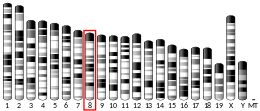 | | Chr. | Chromosome 8 (mouse)[2] |
|---|
| | Band | 8|8 C3 | Start | 88,647,315 bp[2] |
|---|
| End | 88,688,474 bp[2] |
|---|
|
| RNA expression pattern |
|---|
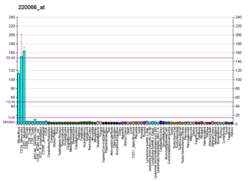 | | More reference expression data |
|
| Gene ontology |
|---|
| Molecular function | • Hsp90 protein binding
• nucleotide binding
• Hsp70 protein binding
• GO:0001948 protein binding
• peptidoglycan binding
• enzyme binding
• actin binding
• CARD domain binding
• ATP binding
• protein kinase binding
• muramyl dipeptide binding
• GO:0032403 macromolecular complex binding
|
|---|
| Cellular component | • cytoplasm
• cytosol
• vesicle
• membrane
• cell membrane
• cell surface
• basolateral plasma membrane
• COP9 signalosome
• cytoskeleton
• Golgi apparatus
• mitochondrion
• macromolecular complex
|
|---|
| Biological process | • positive regulation of prostaglandin-endoperoxide synthase activity
• regulation of apoptotic process
• defense response
• detection of biotic stimulus
• cytokine production involved in immune response
• positive regulation of cytokine production involved in inflammatory response
• GO:0007243 intracellular signal transduction
• detection of muramyl dipeptide
• positive regulation of interleukin-10 production
• positive regulation of epithelial cell proliferation
• immune system process
• positive regulation of oxidoreductase activity
• response to muramyl dipeptide
• positive regulation of prostaglandin-E synthase activity
• positive regulation of JNK cascade
• positive regulation of nitric-oxide synthase biosynthetic process
• positive regulation of NIK/NF-kappaB signaling
• positive regulation of phosphatidylinositol 3-kinase activity
• positive regulation of gamma-delta T cell activation
• cellular response to muramyl dipeptide
• JNK cascade
• negative regulation of macrophage apoptotic process
• positive regulation of dendritic cell antigen processing and presentation
• activation of MAPK activity
• nucleotide-binding oligomerization domain containing 2 signaling pathway
• maintenance of gastrointestinal epithelium
• defense response to bacterium
• positive regulation of NF-kappaB transcription factor activity
• positive regulation of interleukin-8 production
• detection of bacterium
• positive regulation of interleukin-1 beta production
• regulation of inflammatory response
• positive regulation of interleukin-6 production
• protein oligomerization
• positive regulation of tumor necrosis factor production
• positive regulation of ERK1 and ERK2 cascade
• positive regulation of I-kappaB kinase/NF-kappaB signaling
• cytokine secretion involved in immune response
• positive regulation of B cell activation
• positive regulation of interleukin-17 production
• positive regulation of type 2 immune response
• nucleotide-binding oligomerization domain containing signaling pathway
• positive regulation of stress-activated MAPK cascade
• positive regulation of Notch signaling pathway
• positive regulation of transcription from RNA polymerase II promoter
• cellular response to organic cyclic compound
• positive regulation of cell proliferation
• innate immune system
• response to nutrient
• positive regulation of dendritic cell cytokine production
• positive regulation of protein K63-linked ubiquitination
• cellular response to peptidoglycan
• positive regulation of MAP kinase activity
• interleukin-1-mediated signaling pathway
• cellular response to lipopolysaccharide
|
|---|
| Sources:Amigo / QuickGO |
|
| Orthologs |
|---|
| Species | Human | Mouse |
|---|
| Entrez | | |
|---|
| Ensembl | | |
|---|
| UniProt | | |
|---|
| RefSeq (mRNA) | |
|---|
NM_001293557
NM_022162
NM_001370466 |
| |
|---|
| RefSeq (protein) | |
|---|
NP_001280486
NP_071445
NP_001357395 |
| |
|---|
| Location (UCSC) | Chr 16: 50.69 – 50.73 Mb | Chr 8: 88.65 – 88.69 Mb |
|---|
| PubMed search | [3] | [4] |
|---|
| Wikidata |
| View/Edit Human | View/Edit Mouse |
|
NOD2 is an intracellular pattern recognition receptor, which is similar in structure to resistant proteins of plants and recognizes molecules containing the specific structure called muramyl dipeptide (MDP) that is found in certain bacteria.[8]
StructureEdit
NOD2 protein model consisting two N-terminal CARD domains (red) connected via helical linker (blue) with central NOD domain (green). At C-terminus LRR domain (cyan) is located[9]
The C-terminal portion of the protein contains a leucine-rich repeat domain that is known to play a role in protein–protein interactions. The middle part of the protein is characterized by a NOD domain involved in protein self-oligomerization. The N-terminal portion contains two CARD domains known to play a role in apoptosis and NF-κB activation pathways.[10]
FunctionEditThis gene is a member of the NOD1/Apaf-1 family (also known as NOD-like receptor family) and encodes a protein with two caspase recruitment domains (CARDs) and eleven leucine-rich repeats (LRRs). The protein is primarily expressed in the peripheral blood leukocytes. It plays a role in the immune response by recognizing the bacterial molecules which possess the muramyl dipeptide (MDP) moiety and activating the NF-κB protein.[11]
Clinical significanceEditMutations in this gene have been associated with Crohn's disease,[9] Blau syndrome, severe pulmonary sarcoidosis [12] and Graft-versus-host disease.[13]
The NOD2 gene is linked to inflammatory diseases such as Inflammatory bowel disease/Crohn's disease and Blau syndrome.[14][15]
InteractionsEditNOD2 has been shown to interact with NLRC4.[16][17]
NOD2 has also been shown to bind to MAVS in response to ssRNA or viral RNA treatment and activate the IFN response. This is the first report of NOD2 acting as a pattern-recognition receptor for viruses.[18]



