Integrin alpha-11 is a protein that, in humans, is encoded by the ITGA11 gene.[5][6]
| ITGA11 |
|---|
|
| Identifiers |
|---|
| Aliases | ITGA11, HsT18964, integrin subunit alpha 11 |
|---|
| External IDs | OMIM: 604042, 604789 MGI: 2442114 HomoloGene: 8151 GeneCards: ITGA11 |
|---|
| Gene location (Human) |
|---|
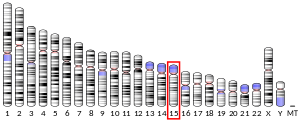 | | Chr. | Chromosome 15 (human)[1] |
|---|
| | Band | 15q23 | Start | 68,296,532 bp[1] |
|---|
| End | 68,432,163 bp[1] |
|---|
|
| Gene location (Mouse) |
|---|
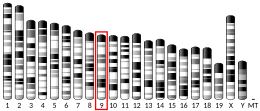 | | Chr. | Chromosome 9 (mouse)[2] |
|---|
| | Band | 9|9 B | Start | 62,677,826 bp[2] |
|---|
| End | 62,783,982 bp[2] |
|---|
|
| RNA expression pattern |
|---|
 | | More reference expression data |
|
| Gene ontology |
|---|
| Molecular function | • collagen receptor activity
• collagen binding involved in cell-matrix adhesion
• collagen binding
• metal ion binding
|
|---|
| Cellular component | • integral component of membrane
• integrin complex
• cell membrane
• integrin alpha11-beta1 complex
• membrane
• focal adhesion
|
|---|
| Biological process | • integrin-mediated signaling pathway
• muscle organ development
• cell adhesion
• cell-matrix adhesion
• extracellular matrix organization
• cell adhesion mediated by integrin
• osteoblast differentiation
• substrate-dependent cell migration
• collagen-activated signaling pathway
|
|---|
| Sources:Amigo / QuickGO |
|
| Orthologs |
|---|
| Species | Human | Mouse |
|---|
| Entrez | | |
|---|
| Ensembl | | |
|---|
| UniProt | | |
|---|
| RefSeq (mRNA) | | |
|---|
| RefSeq (protein) | | |
|---|
| Location (UCSC) | Chr 15: 68.3 – 68.43 Mb | Chr 9: 62.68 – 62.78 Mb |
|---|
| PubMed search | [3] | [4] |
|---|
| Wikidata |
| View/Edit Human | View/Edit Mouse |
|
This gene encodes an alpha integrin. Integrins are heterodimeric integral membrane proteins composed of an alpha chain and a beta chain. This protein contains an I domain, is expressed in muscle tissue, dimerizes with beta 1 integrin in vitro, and appears to bind collagen in this form. Therefore, the protein may be involved in attaching muscle tissue to the extracellular matrix. Alternative transcriptional splice variants have been found for this gene, but their biological validity is not determined.[6]
According to one study, ITGA11 expression is increased in the anterior stroma of corneal buttons excised from the eyes affected by keratoconus.[7]


