Glutamate [NMDA] receptor subunit epsilon-2, also known as N-methyl D-aspartate receptor subtype 2B (NMDAR2B or NR2B), is a protein that in humans is encoded by the GRIN2B gene.[5]
| GRIN2B |
|---|
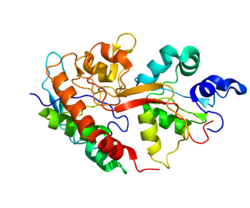 |
| Available structures |
|---|
| PDB | Ortholog search: PDBe RCSB |
|---|
| List of PDB id codes |
|---|
5EWM, 5EWL, 5EWJ |
|
|
| Identifiers |
|---|
| Aliases | GRIN2B, GluN2B, MRD6, NMDAR2B, NR2B, hNR3, EIEE27, glutamate ionotropic receptor NMDA type subunit 2B, NR3 |
|---|
| External IDs | OMIM: 138252 MGI: 95821 HomoloGene: 646 GeneCards: GRIN2B |
|---|
| Gene location (Human) |
|---|
 | | Chr. | Chromosome 12 (human)[1] |
|---|
| | Band | 12p13.1 | Start | 13,437,942 bp[1] |
|---|
| End | 13,981,957 bp[1] |
|---|
|
| Gene location (Mouse) |
|---|
 | | Chr. | Chromosome 6 (mouse)[2] |
|---|
| | Band | 6 G1|6 66.38 cM | Start | 135,713,233 bp[2] |
|---|
| End | 136,173,511 bp[2] |
|---|
|
| RNA expression pattern |
|---|
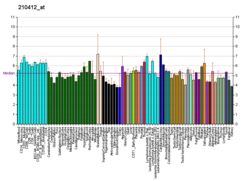
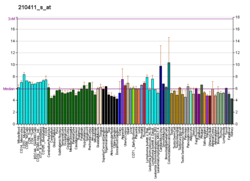 | | More reference expression data |
|
| Gene ontology |
|---|
| Molecular function | • zinc ion binding
• glycine binding
• metal ion binding
• ion channel activity
• GO:0001948 protein binding
• ionotropic glutamate receptor activity
• extracellular-glutamate-gated ion channel activity
• Ras guanyl-nucleotide exchange factor activity
• NMDA glutamate receptor activity
• glutamate binding
• glutamate-gated calcium ion channel activity
• amyloid-beta binding
• signaling receptor activity
|
|---|
| Cellular component | • integral component of membrane
• postsynaptic membrane
• membrane
• synapse
• NMDA selective glutamate receptor complex
• cell surface
• cell junction
• neuron projection
• intracellular
• integral component of plasma membrane
• GO:0097483, GO:0097481 postsynaptic density
• cell membrane
• cytoplasm
• synaptic membrane
• postsynaptic density membrane
|
|---|
| Biological process | • glutamate receptor signaling pathway
• ephrin receptor signaling pathway
• ion transport
• MAPK cascade
• learning or memory
• response to ethanol
• chemical synaptic transmission
• ionotropic glutamate receptor signaling pathway
• excitatory postsynaptic potential
• regulation of ion transmembrane transport
• transport
• calcium-mediated signaling
• protein heterotetramerization
• regulation of molecular function
• calcium ion transmembrane import into cytosol
• multicellular organism development
• brain development
• regulation of synaptic plasticity
• long-term synaptic potentiation
• excitatory chemical synaptic transmission
• positive regulation of neuron death
• negative regulation of dendritic spine maintenance
• positive regulation of cysteine-type endopeptidase activity
• regulation of NMDA receptor activity
|
|---|
| Sources:Amigo / QuickGO |
|
| Orthologs |
|---|
| Species | Human | Mouse |
|---|
| Entrez | | |
|---|
| Ensembl | | |
|---|
| UniProt | | |
|---|
| RefSeq (mRNA) | | |
|---|
| RefSeq (protein) | | |
|---|
| Location (UCSC) | Chr 12: 13.44 – 13.98 Mb | Chr 6: 135.71 – 136.17 Mb |
|---|
| PubMed search | [3] | [4] |
|---|
| Wikidata |
| View/Edit Human | View/Edit Mouse |
|
NMDA receptorsEditN-methyl-D-aspartate (NMDA) receptors are a class of ionotropic glutamate receptors. The NMDA receptor channel has been shown to be involved in long-term potentiation, an activity-dependent increase in the efficiency of synaptic transmission thought to underlie certain kinds of memory and learning. NMDA receptor channels are heterotetramers composed of two molecules of the key receptor subunit NMDAR1 (GRIN1) and two drawn from one or more of the four NMDAR2 subunits: NMDAR2A (GRIN2A), NMDAR2B (GRIN2B), NMDAR2C (GRIN2C), and NMDAR2D (GRIN2D). The NR2 subunit acts as the agonist binding site for glutamate, one of the predominant excitatory neurotransmitter receptors in the mammalian brain.[6]
FunctionEditNR2B has been associated with age- and visual-experience-dependent plasticity in the neocortex of rats, where an increased NR2B/NR2A ratio correlates directly with the stronger excitatory LTP in young animals. This is thought to contribute to experience-dependent refinement of developing cortical circuits.[7]
Both mice and rats that were engineered to over-express GRIN2B in their brains have increased mental ability. The "Doogie" mouse had double the learning ability on one measure of learning.[8][9]



