Growth/differentiation factor 15 (GDF15) was first identified as Macrophage inhibitory cytokine-1 or MIC-1.[5]
| GDF15 |
|---|
|
| Identifiers |
|---|
| Aliases | GDF15, GDF-15, MIC-1, MIC1, NAG-1, PDF, PLAB, PTGFB, growth differentiation factor 15, TGF-PL |
|---|
| External IDs | OMIM: 605312 MGI: 1346047 HomoloGene: 3576 GeneCards: GDF15 |
|---|
| Gene location (Human) |
|---|
 | | Chr. | Chromosome 19 (human)[1] |
|---|
| | Band | 19p13.11 | Start | 18,374,731 bp[1] |
|---|
| End | 18,389,176 bp[1] |
|---|
|
| Gene location (Mouse) |
|---|
 | | Chr. | Chromosome 8 (mouse)[2] |
|---|
| | Band | 8|8 B3.3 | Start | 70,629,393 bp[2] |
|---|
| End | 70,632,456 bp[2] |
|---|
|
| RNA expression pattern |
|---|
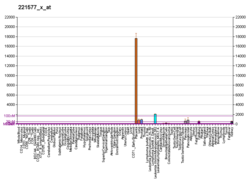 | | More reference expression data |
|
| Gene ontology |
|---|
| Molecular function | • transforming growth factor beta receptor binding
• growth factor activity
• GO:0001948 protein binding
• cytokine activity
• protein homodimerization activity
|
|---|
| Cellular component | • extracellular region
• extracellular exosome
• cell nucleus
• cytoplasm
• extracellular
• Golgi apparatus
• collagen-containing extracellular matrix
|
|---|
| Biological process | • regulation of apoptotic process
• cell-cell signaling
• positive regulation of pathway-restricted SMAD protein phosphorylation
• positive regulation of myoblast fusion
• regulation of MAPK cascade
• transforming growth factor beta receptor signaling pathway
• cell development
• signal transduction
• BMP signaling pathway
• SMAD protein signal transduction
• regulation of receptor activity
• activation of MAPK activity
• reduction of food intake in response to dietary excess
• glial cell-derived neurotrophic factor receptor signaling pathway
• negative regulation of multicellular organism growth
• positive regulation of MAPK cascade
• positive regulation of protein kinase B signaling
• negative regulation of growth hormone receptor signaling pathway
|
|---|
| Sources:Amigo / QuickGO |
|
| Orthologs |
|---|
| Species | Human | Mouse |
|---|
| Entrez | | |
|---|
| Ensembl | | |
|---|
| UniProt | | |
|---|
| RefSeq (mRNA) | | |
|---|
| RefSeq (protein) | | |
|---|
| Location (UCSC) | Chr 19: 18.37 – 18.39 Mb | Chr 8: 70.63 – 70.63 Mb |
|---|
| PubMed search | [3] | [4] |
|---|
| Wikidata |
| View/Edit Human | View/Edit Mouse |
|
It is a protein belonging to the transforming growth factor beta superfamily. Under normal conditions, GDF-15 is expressed in low concentrations in most organs and upregulated because of injury of organs such as such as liver, kidney, heart and lung.[6][7][8]
The function of GDF-15 is not fully cleared but it seems to have a role in regulating inflammatory pathways and to be involved in regulating apoptosis, cell repair and cell growth, which are biological processes observed in cardiovascular and neoplastic disorders.[6][9][10] GDF-15 has shown to be a strong prognostic protein in patients with different diseases such as heart diseases and cancer.[11]
Metformin was shown to cause increased levels of GDF-15. This increase mediates the effect of body weight loss by metformin.[12]
A monoclonal antibody (mAB1) that neutralizes circulating GDF-15 is being tested in mice and non-human primates as a potential treatment for cancer-related cachexia.[13]



