Folate receptor 1 (Folate receptor alpha, FOLR1) is a protein that in humans is encoded by the FOLR1 gene.[5][6]
| FOLR1 |
|---|
|
| Available structures |
|---|
| PDB | Ortholog search: PDBe RCSB |
|---|
| List of PDB id codes |
|---|
4KM6, 4KM7, 4KMX, 4LRH |
|
|
| Identifiers |
|---|
| Aliases | FOLR1, FBP, FOLR, Folate receptor 1, folate receptor 1 (adult), folate receptor alpha, FRalpha |
|---|
| External IDs | OMIM: 136430 MGI: 95568 HomoloGene: 7322 GeneCards: FOLR1 |
|---|
| Gene location (Human) |
|---|
 | | Chr. | Chromosome 11 (human)[1] |
|---|
| | Band | 11q13.4 | Start | 72,189,558 bp[1] |
|---|
| End | 72,196,323 bp[1] |
|---|
|
| Gene location (Mouse) |
|---|
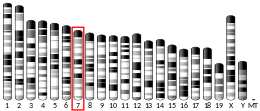 | | Chr. | Chromosome 7 (mouse)[2] |
|---|
| | Band | 7|7 E2 | Start | 101,858,331 bp[2] |
|---|
| End | 101,870,788 bp[2] |
|---|
|
| RNA expression pattern |
|---|
 | | More reference expression data |
|
| Gene ontology |
|---|
| Molecular function | • methotrexate binding
• drug binding
• folic acid receptor activity
• folic acid transporter activity
• folic acid binding
• signaling receptor activity
|
|---|
| Cellular component | • anchored component of external side of plasma membrane
• extracellular region
• brush border
• clathrin-coated vesicle
• ER to Golgi transport vesicle membrane
• anchored component of membrane
• Golgi membrane
• cell nucleus
• integral component of plasma membrane
• apical plasma membrane
• membrane
• cell surface
• endoplasmic reticulum membrane
• brush border membrane
• basolateral plasma membrane
• cell membrane
• cytoplasmic vesicle
• endosome
• endoplasmic reticulum-Golgi intermediate compartment membrane
• anchored component of plasma membrane
• extracellular exosome
• transport vesicle
|
|---|
| Biological process | • receptor-mediated endocytosis
• cellular response to folic acid
• neural crest cell migration involved in heart formation
• axon regeneration
• COPII vesicle coating
• ER to Golgi vesicle-mediated transport
• heart looping
• cardiac neural crest cell migration involved in outflow tract morphogenesis
• pharyngeal arch artery morphogenesis
• folic acid metabolic process
• regulation of transforming growth factor beta receptor signaling pathway
• response to axon injury
• regulation of canonical Wnt signaling pathway
• anterior neural tube closure
• folic acid transport
• transport
• folic acid import across plasma membrane
|
|---|
| Sources:Amigo / QuickGO |
|
| Orthologs |
|---|
| Species | Human | Mouse |
|---|
| Entrez | | |
|---|
| Ensembl | | |
|---|
| UniProt | | |
|---|
| RefSeq (mRNA) | |
|---|
NM_016730
NM_000802
NM_016724
NM_016725
NM_016729 |
| |
|---|
NM_001252552
NM_001252553
NM_001252554
NM_008034 |
|
|---|
| RefSeq (protein) | |
|---|
NP_000793
NP_057936
NP_057937
NP_057941 |
| |
|---|
NP_001239481
NP_001239482
NP_001239483
NP_032060 |
|
|---|
| Location (UCSC) | Chr 11: 72.19 – 72.2 Mb | Chr 7: 101.86 – 101.87 Mb |
|---|
| PubMed search | [3] | [4] |
|---|
| Wikidata |
| View/Edit Human | View/Edit Mouse |
|
The protein encoded by this gene is a member of the folate receptor (FOLR) family. Members of this family have a high affinity for folic acid and for several reduced folic acid derivatives, and mediate delivery of 5-methyltetrahydrofolate to the interior of cells.
This gene is composed of 7 exons; exons 1 through 4 encode the 5' UTR and exons 4 through 7 encode the open reading frame. Due to the presence of 2 promoters, multiple transcription start sites, and alternative splicing of exons, several transcript variants are derived from this gene. These variants differ in the lengths of 5' and 3' UTR, but they encode an identical amino acid sequence.[6]
Clinical significanceEditFRA can be overexpressed by a number of epithelial-derived tumors including ovarian, breast, renal, lung, colorectal, and brain. Hence antibodies to it are used in targeted therapies and diagnostic tests, e.g. farletuzumab in phase III trial for ovarian cancer.
Autoantibodies to the FRA have been linked to neurodevelopmental diseases,[7] particularly cerebral folate deficiency[8] schizophrenia[8] and autism spectrum disorder.[9] Recent studies have shown that these neurodevelopmental disorders can be treated with folinic acid.[9][10]
FiguresEdit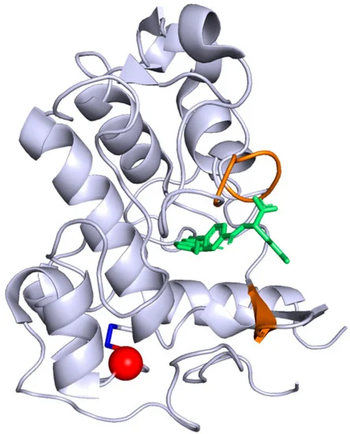
Crystallographic structure of FRα protein. The folate is in green, the folate binding site is colored in orange. A Cys66Tyr substitution position induced by a pathogenic variant is represented in red while the disulfide bond between Cys66 and Cys109 is in dark blue. Figure from Mafi et al., 2020[11]



