Crk-like protein is a protein that in humans is encoded by the CRKL gene.[5][6]
| CRKL |
|---|
 |
| Available structures |
|---|
| PDB | Ortholog search: PDBe RCSB |
|---|
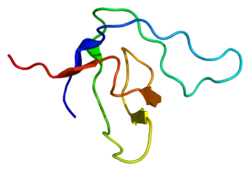
| List of PDB id codes |
|---|
2BZX, 2BZY, 2EO3, 2LQN, 2LQW |
|
|
| Identifiers |
|---|
| Aliases | CRKL, CRK like proto-oncogene, adaptor protein |
|---|
| External IDs | OMIM: 602007 MGI: 104686 HomoloGene: 38021 GeneCards: CRKL |
|---|
| Gene location (Human) |
|---|
 | | Chr. | Chromosome 22 (human)[1] |
|---|
| | Band | 22q11.21 | Start | 20,917,407 bp[1] |
|---|
| End | 20,953,747 bp[1] |
|---|
|
| Gene location (Mouse) |
|---|
 | | Chr. | Chromosome 16 (mouse)[2] |
|---|
| | Band | 16|16 A3 | Start | 17,451,987 bp[2] |
|---|
| End | 17,487,434 bp[2] |
|---|
|
| RNA expression pattern |
|---|
 | | More reference expression data |
|
| Gene ontology |
|---|
| Molecular function | • GO:0001948 protein binding
• signal transducer activity
• RNA binding
• cadherin binding
• phosphotyrosine residue binding
• identical protein binding
|
|---|
| Cellular component | • cytoplasm
• cytosol
• endosome
• extracellular exosome
• nucleoplasm
• neuromuscular junction
• macromolecular complex
• synapse
• extrinsic component of postsynaptic membrane
|
|---|
| Biological process | • animal organ morphogenesis
• pattern specification process
• JNK cascade
• heart development
• Ras protein signal transduction
• GO:0007243 intracellular signal transduction
• blood vessel development
• parathyroid gland development
• anterior/posterior pattern specification
• positive regulation of cell proliferation
• activation of MAPKK activity
• thymus development
• positive regulation of substrate adhesion-dependent cell spreading
• activation of MAPK activity
• regulation of cell growth
• urogenital system development
• neuron migration
• B cell apoptotic process
• negative regulation of protein phosphorylation
• positive regulation of protein phosphorylation
• regulation of leukocyte migration
• outflow tract morphogenesis
• lipid metabolism
• spermatogenesis
• single fertilization
• synapse assembly
• fibroblast growth factor receptor signaling pathway
• male gonad development
• regulation of gene expression
• negative regulation of gene expression
• dendrite development
• cytokine-mediated signaling pathway
• hippocampus development
• cerebral cortex development
• establishment of cell polarity
• regulation of cell adhesion mediated by integrin
• helper T cell diapedesis
• cellular response to drug
• reelin-mediated signaling pathway
• positive regulation of Ras protein signal transduction
• retinoic acid receptor signaling pathway
• regulation of dendrite development
• T cell receptor signaling pathway
• cell chemotaxis
• pharynx development
• positive regulation of ERK1 and ERK2 cascade
• cellular response to transforming growth factor beta stimulus
• response to fibroblast growth factor
• endothelin receptor signaling pathway
• GO:0032861, GO:0032862, GO:0032856 activation of GTPase activity
• acetylcholine receptor signaling pathway
• cerebellar neuron development
• cellular response to interleukin-7
• positive regulation of glial cell migration
• regulation of skeletal muscle acetylcholine-gated channel clustering
• cranial skeletal system development
• regulation of T cell migration
|
|---|
| Sources:Amigo / QuickGO |
|
| Orthologs |
|---|
| Species | Human | Mouse |
|---|
| Entrez | | |
|---|
| Ensembl | | |
|---|
| UniProt | | |
|---|
| RefSeq (mRNA) | | |
|---|
| RefSeq (protein) | | |
|---|
| Location (UCSC) | Chr 22: 20.92 – 20.95 Mb | Chr 16: 17.45 – 17.49 Mb |
|---|
| PubMed search | [3] | [4] |
|---|
| Wikidata |
| View/Edit Human | View/Edit Mouse |
|
FunctionEditv-CRK avian sarcoma virus CT10-homolog-like contains one SH2 domain and two SH3 domains. CRKL has been shown to activate the RAS and JUN kinase signaling pathways and transform fibroblasts in a RAS-dependent fashion. It is a substrate of the BCR-ABL tyrosine kinase and plays a role in fibroblast transformation by BCR-ABL. In addition, CRKL has oncogenic potential.[7]
CrkL together with Crk participates in the Reelin signaling cascade downstream of DAB1.[8][9]


