Cathepsin A is an enzyme that is classified both as a cathepsin and a carboxypeptidase. In humans, it is encoded by the CTSA gene.[5]
| CTSA |
|---|
 |
| Available structures |
|---|
| PDB | Ortholog search: PDBe RCSB |
|---|
| List of PDB id codes |
|---|
1IVY, 3BP4, 3BP7, 3BXN, 4AZ0, 4AZ3, 4CI9, 4CIA, 4CIB, 4MWS, 4MWT |
|
|
| Identifiers |
|---|
| Aliases | CTSA, GLB2, GSL, NGBE, PPCA, PPGB, cathepsin A |
|---|
| External IDs | OMIM: 613111 MGI: 97748 HomoloGene: 80163 GeneCards: CTSA |
|---|
| Gene location (Human) |
|---|
 | | Chr. | Chromosome 20 (human)[1] |
|---|
| | Band | 20q13.12 | Start | 45,890,144 bp[1] |
|---|
| End | 45,898,820 bp[1] |
|---|
|
| Gene location (Mouse) |
|---|
 | | Chr. | Chromosome 2 (mouse)[2] |
|---|
| | Band | 2 H3|2 85.27 cM | Start | 164,832,873 bp[2] |
|---|
| End | 164,841,032 bp[2] |
|---|
|
| RNA expression pattern |
|---|
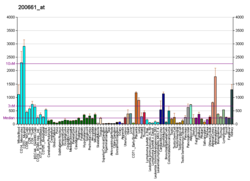 | | More reference expression data |
|
| Gene ontology |
|---|
| Molecular function | • peptidase activity
• carboxypeptidase activity
• GO:0010577 enzyme activator activity
• hydrolase activity
• exo-alpha-sialidase activity
• serine-type carboxypeptidase activity
|
|---|
| Cellular component | • membrane
• intracellular membrane-bounded organelle
• nucleoplasm
• lysosomal lumen
• endoplasmic reticulum
• lysosome
• lumenal side of lysosomal membrane
• extracellular exosome
• extracellular region
• azurophil granule lumen
|
|---|
| Biological process | • regulation of protein stability
• glycosphingolipid metabolic process
• proteolysis
• regulation of chaperone-mediated autophagy
• proteolysis involved in cellular protein catabolic process
• intracellular protein transport
• GO:0048554 positive regulation of catalytic activity
• neutrophil degranulation
• negative regulation of chaperone-mediated autophagy
|
|---|
| Sources:Amigo / QuickGO |
|
| Orthologs |
|---|
| Species | Human | Mouse |
|---|
| Entrez | | |
|---|
| Ensembl | | |
|---|
| UniProt | | |
|---|
| RefSeq (mRNA) | |
|---|
NM_001167594
NM_000308
NM_001127695 |
| |
|---|
| RefSeq (protein) | |
|---|
NP_000299
NP_001121167
NP_001161066 |
| |
|---|
| Location (UCSC) | Chr 20: 45.89 – 45.9 Mb | Chr 2: 164.83 – 164.84 Mb |
|---|
| PubMed search | [3] | [4] |
|---|
| Wikidata |
| View/Edit Human | View/Edit Mouse |
|
FunctionEditThis gene encodes a glycoprotein that associates with lysosomal enzymes beta-galactosidase and neuraminidase to form a complex of high-molecular-weight multimers. The formation of this complex provides a protective role for stability and activity. It is protective for β-galactosidase and neuraminidase.[6]
Clinical significanceEditDeficiencies in this gene are linked to multiple forms of galactosialidosis.[5]
InteractionsEditCathepsin A has been shown to interact with NEU1.[7]


