Bruton's tyrosine kinase (abbreviated Btk or BTK), also known as tyrosine-protein kinase BTK, is a tyrosine kinase that is encoded by the BTK gene in humans. BTK plays a crucial role in B cell development.
| BTK |
|---|
 |
| Available structures |
|---|
| PDB | Ortholog search: PDBe RCSB |
|---|
| List of PDB id codes |
|---|
1AWW, 1AWX, 1B55, 1BTK, 1BWN, 1K2P, 1QLY, 2GE9, 2Z0P, 3GEN, 3K54, 3OCS, 3OCT, 3P08, 3PIX, 3PIY, 3PIZ, 3PJ1, 3PJ2, 3PJ3, 4NWM, 4OT5, 4OT6, 4OTF, 4OTQ, 4OTR, 4RFY, 4RFZ, 4RG0, 4YHF, 4Z3V, 4ZLY, 4ZLZ, 5BPY, 5BQ0, 5FBN, 4RX5, 5FBO |
|
|
| Identifiers |
|---|
| Aliases | BTK, AGMX1, AT, ATK, BPK, IMD1, PSCTK1, XLA, Bruton tyrosine kinase, IGHD3 |
|---|
| External IDs | OMIM: 300300 MGI: 88216 HomoloGene: 30953 GeneCards: BTK |
|---|
| Gene location (Human) |
|---|
 | | Chr. | X chromosome (human)[1] |
|---|
| | Band | Xq22.1 | Start | 101,349,447 bp[1] |
|---|
| End | 101,390,796 bp[1] |
|---|
|
| Gene location (Mouse) |
|---|
 | | Chr. | X chromosome (mouse)[2] |
|---|
| | Band | X E3|X 56.18 cM | Start | 134,542,336 bp[2] |
|---|
| End | 134,583,570 bp[2] |
|---|
|
| RNA expression pattern |
|---|
 | | More reference expression data |
|
| Gene ontology |
|---|
| Molecular function | • metal ion binding
• nucleotide binding
• lipid binding
• receptor binding
• identical protein binding
• protein kinase activity
• transferase activity
• kinase activity
• phosphatidylinositol-3,4,5-trisphosphate binding
• non-membrane spanning protein tyrosine kinase activity
• ATP binding
• GO:0001948 protein binding
• protein tyrosine kinase activity
|
|---|
| Cellular component | • cytoplasm
• cell nucleus
• membrane
• membrane raft
• extrinsic component of cytoplasmic side of plasma membrane
• cytoplasmic vesicle
• cytosol
• cell membrane
• perinuclear region of cytoplasm
• mast cell granule
|
|---|
| Biological process | • transmembrane receptor protein tyrosine kinase signaling pathway
• mesoderm development
• GO:0007243 intracellular signal transduction
• peptidyl-tyrosine autophosphorylation
• B cell activation
• positive regulation of NF-kappaB transcription factor activity
• transcription, DNA-templated
• positive regulation of B cell differentiation
• B cell receptor signaling pathway
• Fc-epsilon receptor signaling pathway
• regulation of cell proliferation
• adaptive immune response
• apoptotic process
• peptidyl-tyrosine phosphorylation
• protein phosphorylation
• negative regulation of cytokine production
• MyD88-dependent toll-like receptor signaling pathway
• apoptotic signaling pathway
• calcium-mediated signaling
• I-kappaB kinase/NF-kappaB signaling
• innate immune system
• regulation of transcription, DNA-templated
• cell maturation
• immune system process
• regulation of B cell cytokine production
• regulation of B cell apoptotic process
• phosphorylation
• histamine secretion by mast cell
• response to organic substance
• positive regulation of type III hypersensitivity
• autophosphorylation
• cellular response to reactive oxygen species
• cellular response to molecule of fungal origin
• positive regulation of type I hypersensitivity
• B cell affinity maturation
• negative regulation of B cell proliferation
• cellular response to interleukin-7
• T cell receptor signaling pathway
• G-protein coupled receptor signaling pathway
|
|---|
| Sources:Amigo / QuickGO |
|
| Orthologs |
|---|
| Species | Human | Mouse |
|---|
| Entrez | | |
|---|
| Ensembl | | |
|---|
| UniProt | | |
|---|
| RefSeq (mRNA) | |
|---|
NM_001287345
NM_000061
NM_001287344 |
| |
|---|
| RefSeq (protein) | |
|---|
NP_000052
NP_001274273
NP_001274274 |
| |
|---|
| Location (UCSC) | Chr X: 101.35 – 101.39 Mb | Chr X: 134.54 – 134.58 Mb |
|---|
| PubMed search | [3] | [4] |
|---|
| Wikidata |
| View/Edit Human | View/Edit Mouse |
|
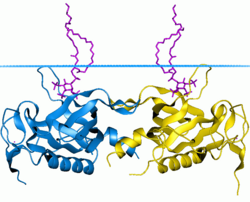
StructureEditBTK contains five different protein interaction domains. These domains include an amino terminal pleckstrin homology (PH) domain, a proline-rich TEC homology (TH) domain, SRC homology (SH) domains SH2 and SH3, as well as a kinase domain with enzymatic activity.[5]
FunctionEditBTK plays a crucial role in B cell development as it is required for transmitting signals from the pre-B cell receptor that forms after successful immunoglobulin heavy chain rearrangement.[6] It also has a role in mast cell activation through the high-affinity IgE receptor.[7]
Btk contains a PH domain that binds phosphatidylinositol (3,4,5)-trisphosphate (PIP3). PIP3 binding induces Btk to phosphorylate phospholipase C, which in turn hydrolyzes PIP2, a phosphatidylinositol, into two second messengers, inositol triphosphate (IP3) and diacylglycerol (DAG), which then go on to modulate the activity of downstream proteins during B-cell signalling.[citation needed]
Clinical significanceEditMutations in the BTK gene are implicated in the primary immunodeficiency disease X-linked agammaglobulinemia (Bruton's agammaglobulinemia); sometimes abbreviated to XLA and selective IgM deficiency.[8] Patients with XLA have normal pre-B cell populations in their bone marrow but these cells fail to mature and enter the circulation. The Btk gene is located on the X chromosome (Xq21.3-q22).[9] At least 400 mutations of the BTK gene have been identified.
BTK inhibitorsEdit
Approved drugs that inhibit BTK:
- Ibrutinib (PCI-32765), a selective Bruton's tyrosine kinase inhibitor.
- Acalabrutinib, approved in October 2017[10] for relapsed mantle cell lymphoma
- Zanubrutinib for mantle cell lymphoma.[11] It can be taken orally.[12]
Various drugs that inhibit BTK are in clinical trials:[13]
- Phase 3:
- Acalabrutinib, for relapsed chronic lymphocytic leukemia (CLL), 95% overall remission reported.
- Phase 2:
- Evobrutinib for multiple sclerosis.[14][15]
- ABBV-105 for systemic lupus erythematosus (SLE)[16]
- Fenebrutinib (GDC-0853, RG7845) for rheumatoid arthritis, systemic lupus erythematosus and chronic spontaneous urticaria.[17]
- Phase 1:
- ONO-4059 for non-Hodgkin lymphoma and/or CLL.[18] Renamed GS-4059 and now in trial NCT02457598.[19]
- Spebrutinib (AVL-292, CC-292) [20]
- HM71224 for autoimmune diseases, under development by Hanmi Pharmaceutical and Lilly as of 2015[21]
DiscoveryEditBruton's tyrosine kinase was discovered in 1993 and is named for Ogden Bruton, who first described XLA in 1952.[9]




