Apoptotic protease activating factor 1, also known as APAF1, is a human homolog of C. elegans CED-4 gene.[5][6][7]
| APAF1 |
|---|
 |
| Available structures |
|---|
| PDB | Ortholog search: PDBe RCSB |
|---|
| List of PDB id codes |
|---|
1C15, 1CWW, 1CY5, 1Z6T, 2P1H, 2YGS, 3J2T, 3YGS, 4RHW, 3JBT |
|
|
| Identifiers |
|---|
| Aliases | APAF1, APAF-1, CED4, apoptotic peptidase activating factor 1 |
|---|
| External IDs | OMIM: 602233 MGI: 1306796 HomoloGene: 7626 GeneCards: APAF1 |
|---|
| Gene location (Human) |
|---|
 | | Chr. | Chromosome 12 (human)[1] |
|---|
| | Band | 12q23.1 | Start | 98,645,141 bp[1] |
|---|
| End | 98,735,433 bp[1] |
|---|
|
| Gene location (Mouse) |
|---|
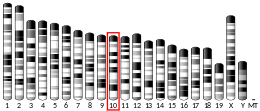 | | Chr. | Chromosome 10 (mouse)[2] |
|---|
| | Band | 10 C2|10 45.47 cM | Start | 90,989,311 bp[2] |
|---|
| End | 91,082,770 bp[2] |
|---|
|
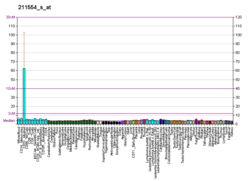
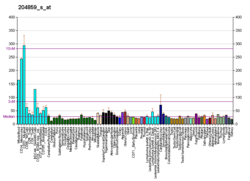
| RNA expression pattern |
|---|

 | | More reference expression data |
|
| Gene ontology |
|---|
| Molecular function | • heat shock protein binding
• ADP binding
• GO:0001948 protein binding
• identical protein binding
• ATP binding
• nucleotide binding
• cysteine-type endopeptidase activator activity involved in apoptotic process
|
|---|
| Cellular component | • cytoplasm
• cytosol
• extracellular exosome
• cell nucleus
• apoptosome
• extracellular region
• secretory granule lumen
• ficolin-1-rich granule lumen
• macromolecular complex
|
|---|
| Biological process | • cellular response to transforming growth factor beta stimulus
• neuron apoptotic process
• regulation of apoptotic process
• cell differentiation
• response to hypoxia
• response to nutrient
• response to G1 DNA damage checkpoint signaling
• aging
• positive regulation of apoptotic signaling pathway
• glial cell apoptotic process
• nervous system development
• multicellular organism development
• cardiac muscle cell apoptotic process
• intrinsic apoptotic signaling pathway
• intrinsic apoptotic signaling pathway in response to endoplasmic reticulum stress
• neural tube closure
• brain development
• positive regulation of apoptotic process
• apoptotic signaling pathway
• forebrain development
• regulation of apoptotic DNA fragmentation
• protein homooligomerization
• activation of cysteine-type endopeptidase activity involved in apoptotic process
• activation of cysteine-type endopeptidase activity involved in apoptotic process by cytochrome c
• apoptotic process
• neutrophil degranulation
• negative regulation of G0 to G1 transition
• kidney development
|
|---|
| Sources:Amigo / QuickGO |
|
| Orthologs |
|---|
| Species | Human | Mouse |
|---|
| Entrez | | |
|---|
| Ensembl | | |
|---|
| UniProt | | |
|---|
| RefSeq (mRNA) | |
|---|
NM_001160
NM_013229
NM_181861
NM_181868
NM_181869 |
| |
|---|
NM_001042558
NM_001282947
NM_009684 |
|
|---|
| RefSeq (protein) | |
|---|
NP_001151
NP_037361
NP_863651
NP_863658
NP_863659 |
| |
|---|
NP_001036023
NP_001269876
NP_033814 |
|
|---|
| Location (UCSC) | Chr 12: 98.65 – 98.74 Mb | Chr 10: 90.99 – 91.08 Mb |
|---|
| PubMed search | [3] | [4] |
|---|
| Wikidata |
| View/Edit Human | View/Edit Mouse |
|
FunctionEditThis gene encodes a cytoplasmic protein that forms one of the central hubs in the apoptosis regulatory network. This protein contains (from the N terminal) a caspase recruitment domain (CARD), an ATPase domain (NB-ARC), few short helical domains and then several copies of the WD40 repeat domain. Upon binding cytochrome c and dATP, this protein forms an oligomeric apoptosome. The apoptosome binds and cleaves Procaspase-9 protein, releasing its mature, activated form. The precise mechanism for this reaction is still debated though work published by Guy Salvesen suggests that the apoptosome may induce caspase-9 dimerization and subsequent autocatalysis.[8] Activated caspase-9 stimulates the subsequent caspase cascade that commits the cell to apoptosis.
Alternative splicing results in several transcript variants encoding different isoforms.[5]
StructureEditAPAF1 contains a CARD domain with a Greek key motif composed of six helices, a Rossman fold nucleotide binding domains, a short helical motif and a winged-helix domain.[9]



