Adapter molecule crk also known as proto-oncogene c-Crk is a protein that in humans is encoded by the CRK gene.[5]
| CRK |
|---|
 |
| Available structures |
|---|
| PDB | Ortholog search: PDBe RCSB |
|---|
| List of PDB id codes |
|---|
1JU5, 2DVJ, 2EYV, 2EYW, 2EYX, 2EYY, 2EYZ, 2MS4 |
|
|
| Identifiers |
|---|
| Aliases | CRK, CRKII, p38, v-crk avian sarcoma virus CT10 oncogene homolog, CRK proto-oncogene, adaptor protein |
|---|
| External IDs | OMIM: 164762 MGI: 88508 HomoloGene: 81850 GeneCards: CRK |
|---|
| Gene location (Human) |
|---|
 | | Chr. | Chromosome 17 (human)[1] |
|---|
| | Band | 17p13.3 | Start | 1,420,689 bp[1] |
|---|
| End | 1,463,162 bp[1] |
|---|
|
| Gene location (Mouse) |
|---|
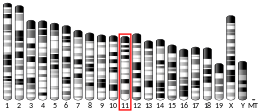 | | Chr. | Chromosome 11 (mouse)[2] |
|---|
| | Band | 11 B5|11 45.92 cM | Start | 75,679,259 bp[2] |
|---|
| End | 75,706,908 bp[2] |
|---|
|
| RNA expression pattern |
|---|

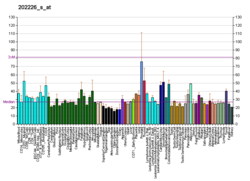
 | | More reference expression data |
|
| Gene ontology |
|---|
| Molecular function | • protein binding, bridging
• protein domain specific binding
• ephrin receptor binding
• GO:0001948 protein binding
• enzyme binding
• insulin-like growth factor receptor binding
• cytoskeletal protein binding
• scaffold protein binding
• phosphotyrosine residue binding
• SH3 domain binding
• SH2 domain binding
• protein self-association
• protein phosphorylated amino acid binding
• protein tyrosine kinase binding
|
|---|
| Cellular component | • cytoplasm
• cytosol
• membrane
• cell membrane
• actin cytoskeleton
• extracellular exosome
• cell nucleus
• membrane raft
• macromolecular complex
|
|---|
| Biological process | • activation of MAPKK activity
• Fc-gamma receptor signaling pathway involved in phagocytosis
• GO:0043087, GO:0032313, GO:0032319, GO:0032314, GO:0043088 regulation of GTPase activity
• ephrin receptor signaling pathway
• regulation of transcription from RNA polymerase II promoter
• regulation of Rac protein signal transduction
• vascular endothelial growth factor receptor signaling pathway
• regulation of actin cytoskeleton organization
• positive regulation of substrate adhesion-dependent cell spreading
• response to yeast
• positive regulation of smooth muscle cell migration
• response to hepatocyte growth factor
• response to hydrogen peroxide
• negative regulation of natural killer cell mediated cytotoxicity
• cellular response to transforming growth factor beta stimulus
• cellular response to nitric oxide
• response to peptide
• cellular response to nerve growth factor stimulus
• cellular response to insulin-like growth factor stimulus
• cellular response to endothelin
• regulation of cell shape
• regulation of signal transduction
• positive regulation of cell growth
• regulation of protein binding
• regulation of wound healing
• negative regulation of wound healing
• response to cholecystokinin
• regulation of cell motility
• negative regulation of cell motility
• neuron migration
• regulation of leukocyte migration
• lipid metabolism
• dendrite development
• cytokine-mediated signaling pathway
• hippocampus development
• cerebral cortex development
• establishment of cell polarity
• regulation of cell adhesion mediated by integrin
• helper T cell diapedesis
• reelin-mediated signaling pathway
• regulation of dendrite development
• cell chemotaxis
• GO:0032861, GO:0032862, GO:0032856 activation of GTPase activity
• cerebellar neuron development
• regulation of T cell migration
|
|---|
| Sources:Amigo / QuickGO |
|
| Orthologs |
|---|
| Species | Human | Mouse |
|---|
| Entrez | | |
|---|
| Ensembl | | |
|---|
| UniProt | | |
|---|
| RefSeq (mRNA) | | |
|---|
NM_001277219
NM_001277221
NM_133656 |
|
|---|
| RefSeq (protein) | | |
|---|
NP_001264148
NP_001264150
NP_598417 |
|
|---|
| Location (UCSC) | Chr 17: 1.42 – 1.46 Mb | Chr 11: 75.68 – 75.71 Mb |
|---|
| PubMed search | [3] | [4] |
|---|
| Wikidata |
| View/Edit Human | View/Edit Mouse |
|
The CRK protein participates in the Reelin signaling cascade downstream of DAB1.[6][7]
FunctionEditAdapter molecule crk is a member of an adapter protein family that binds to several tyrosine-phosphorylated proteins. This protein has several SH2 and SH3 domains (src-homology domains) and is involved in several signaling pathways, recruiting cytoplasmic proteins in the vicinity of tyrosine kinase through SH2-phosphotyrosine interaction. The N-terminal SH2 domain of this protein functions as a positive regulator of transformation whereas the C-terminal SH3 domain functions as a negative regulator of transformation. Two alternative transcripts encoding different isoforms with distinct biological activity have been described.[8]
Crk together with CrkL participates in the Reelin signaling cascade downstream of DAB1.[6][7]
v-Crk, a transforming oncoprotein from avian sarcoma viruses, is a fusion of viral "gag" protein with the SH2 and SH3 domains of cellular Crk.[9] The name Crk is from "CT10 Regulator of Kinase" where CT10 is the avian virus from which was isolated a protein, lacking kinase domains, but capable of stimulating phosphorylation of tyrosines in cells.[10]
Crk should not be confused with Src, which also has cellular (c-Src) and viral (v-Src) forms and is involved in some of the same signaling pathways but is a protein tyrosine-kinase.



