Lysosomal acid phosphatase is an enzyme that in humans is encoded by the ACP2 gene.[5][6]
| ACP2 |
|---|
|
| Identifiers |
|---|
| Aliases | ACP2, acid phosphatase 2, lysosomal, LAP |
|---|
| External IDs | OMIM: 171650 MGI: 87882 HomoloGene: 1217 GeneCards: ACP2 |
|---|
| Gene location (Human) |
|---|
 | | Chr. | Chromosome 11 (human)[1] |
|---|
| | Band | 11p11.2|11p12-p11 | Start | 47,239,302 bp[1] |
|---|
| End | 47,248,906 bp[1] |
|---|
|
| Gene location (Mouse) |
|---|
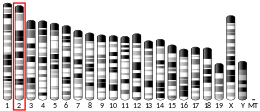 | | Chr. | Chromosome 2 (mouse)[2] |
|---|
| | Band | 2 E1|2 50.54 cM | Start | 91,202,885 bp[2] |
|---|
| End | 91,214,098 bp[2] |
|---|
|
| RNA expression pattern |
|---|
 | | More reference expression data |
|
| Gene ontology |
|---|
| Molecular function | • hydrolase activity
• acid phosphatase activity
|
|---|
| Cellular component | • integral component of membrane
• lysosomal membrane
• lysosome
• lysosomal lumen
• extracellular exosome
• membrane
|
|---|
| Biological process | • skeletal system development
• lysosome organization
• dephosphorylation
|
|---|
| Sources:Amigo / QuickGO |
|
| Orthologs |
|---|
| Species | Human | Mouse |
|---|
| Entrez | | |
|---|
| Ensembl | | |
|---|
| UniProt | | |
|---|
| RefSeq (mRNA) | NM_001131064
NM_001302489
NM_001302490
NM_001302491
NM_001302492
|
|---|
NM_001610
NM_001357016 |
| |
|---|
| RefSeq (protein) | NP_001289418
NP_001289419
NP_001289420
NP_001289421
NP_001601
|
|---|
NP_001343945 |
| |
|---|
| Location (UCSC) | Chr 11: 47.24 – 47.25 Mb | Chr 2: 91.2 – 91.21 Mb |
|---|
| PubMed search | [3] | [4] |
|---|
| Wikidata |
| View/Edit Human | View/Edit Mouse |
|
Lysosomal acid phosphatase is composed of two subunits, alpha and beta, and is chemically and genetically distinct from red cell acid phosphatase. Lysosomal acid phosphatase 2 is a member of a family of distinct isoenzymes which hydrolyze orthophosphoric monoesters to alcohol and phosphate. Acid phosphatase deficiency is caused by mutations in the ACP2 (beta subunit) and ACP3 (alpha subunit) genes.[6]



